
Sep 30, 20267 min read
Guided Walks Versus Audio Apps Compared
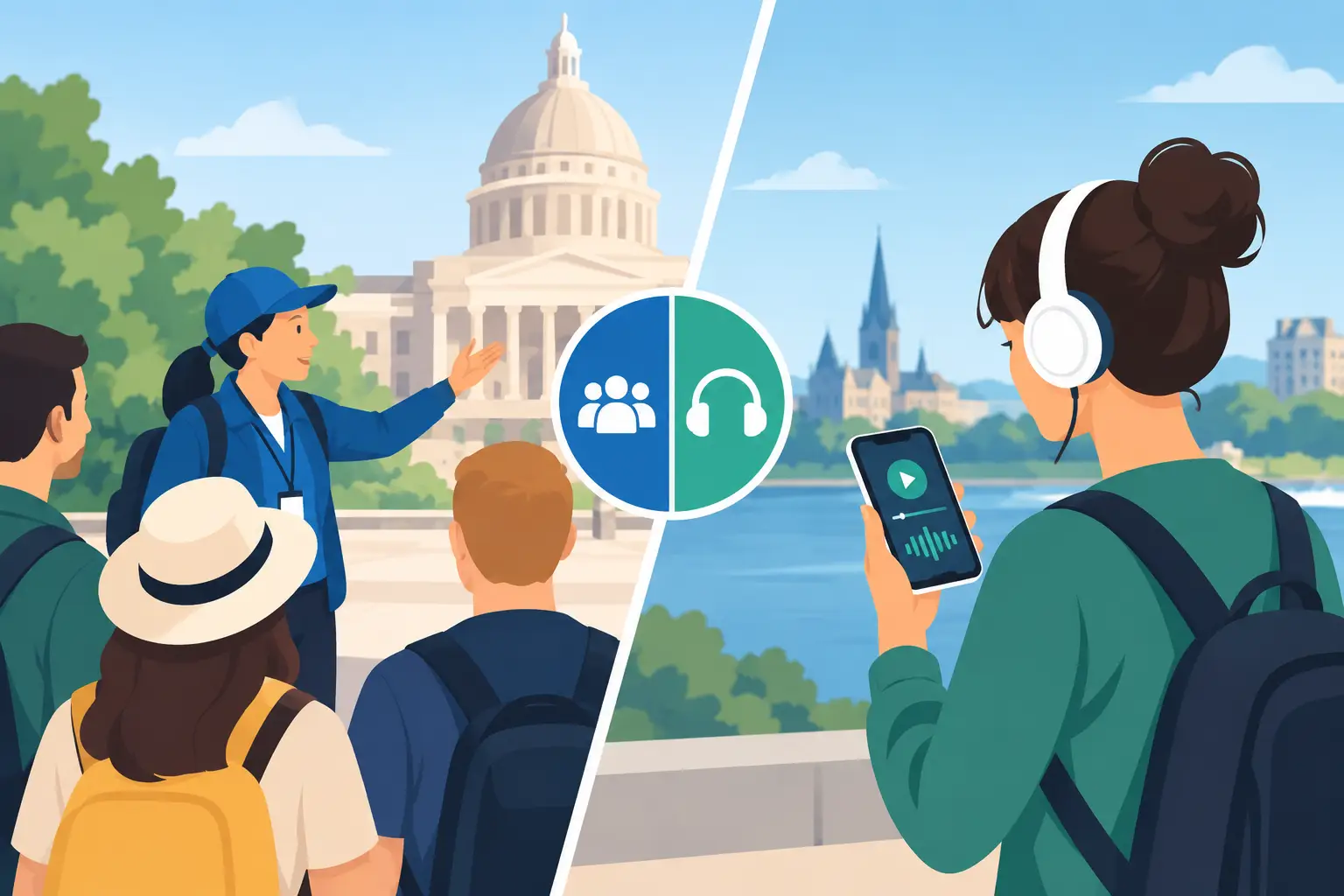
A stranger pauses beside a mural, points to a faded detail near the corner, and tells the story that changed how locals see the block. That moment explains the real choice in guided walks versus audio apps. It is not simply a question of whether you want a person or a pair of headphones. It is a question of how you want a city to respond to you.
For some travelers, the best day out includes a guide who can read the room, answer the odd question, and detour when a street festival blocks the route. For others, freedom is the point: start at midnight, pause for coffee, skip a stop, and follow curiosity without watching a clock. Both formats can reveal a place. Their difference lies in the kind of experience they create.
Guided walks versus audio apps: the core difference
A guided walk is a live, shared event. A good guide does more than recite dates and architectural styles. They adjust the story for a family with teenagers, a history-obsessed visitor, or a group that wants the food scene as much as the landmarks. They notice the weather, local traffic, and the energy of the group. The route becomes a conversation.
An audio app is an on-demand experience. It gives travelers control over timing, pace, and often price. You can take a break without apologizing, replay a story, and explore alone or with your own group. In a busy city, that autonomy can feel like a luxury.
The trade-off is clear. Live tours are more responsive, but tied to a schedule and a specific group dynamic. Audio apps are more flexible, but they can become passive if they ask you only to listen and walk. The strongest mobile experiences solve that problem by making the city part of the game.
Where guided walks still win
Human guides bring local judgment that technology cannot fully predict. Ask where to find the neighborhood bakery locals actually use, whether a market is worth visiting on a rainy Tuesday, or why a building matters to people who live nearby. A knowledgeable guide can give a useful, specific answer on the spot.
They also create social momentum. Solo travelers often join guided walks because the tour itself becomes an easy way to meet people. Couples and friends may enjoy the shared energy of a guide who can turn a familiar plaza into a dramatic scene. For groups with accessibility needs, language questions, or a deep interest in a niche topic, a live guide can make the day easier and more personal.
Guided walks are especially valuable when the story depends on interpretation. A civil rights district, a working harbor, a religious site, or a rapidly changing neighborhood may need more than polished narration. A local guide can explain context carefully, respond to difficult questions, and avoid reducing a living community to a sightseeing backdrop.
But the format has limits. A guide has one departure time, one route, and a finite group size. If the group is too large, the experience can turn into a moving lecture. If the guide is not engaging, there is no skip button. Travelers also have to commit to the pace, even when their attention shifts elsewhere.
Why audio apps fit the way people travel now
Travel does not always happen on schedule. A delayed train, a late hotel check-in, a sudden burst of energy after dinner - these moments can make a fixed tour impractical. An audio app puts exploration in your pocket when the city is open and you are ready.
That freedom matters most for independent travelers. You can begin at the stop nearest your hotel, reverse the route, linger in a museum, or take a detour because a side street looks promising. The experience belongs to your day rather than asking your day to fit around it.
Audio apps can also make local stories more accessible. They often cost less than a private or small-group tour, can be offered in multiple languages, and scale without requiring a guide to be present at every departure. For destination organizations and creators, that opens a new way to share stories beyond the limits of a traditional calendar.
Still, basic audio alone has a familiar weakness. After the third stop, listening can start to feel like consuming a podcast outdoors. You may hear about the city without truly interacting with it. The phone becomes a narrator rather than a reason to look up.
The next step is not just audio. It is participation.
The most memorable self-guided experiences borrow the best part of a live walk: active attention. Instead of sending people from plaque to plaque, they ask explorers to spot a symbol, solve a clue, choose a path, collect a virtual item, or use GPS to trigger the next chapter of a story.
That shift changes the role of the traveler. You are no longer following instructions at a distance. You are searching, deciding, and noticing. A historic square becomes a scene to investigate. A waterfront becomes a mission route. A public artwork becomes evidence in a city-scale puzzle.
This approach works because cities are already layered environments. There are details above eye level, stories behind storefronts, traces of former industries, and overlooked links between neighborhoods. Interactivity gives people a reason to pay attention to those layers. It turns screen time into street time.
Leplace is built around this idea: interactive self-guided tours that blend real-world discovery, local storytelling, and game mechanics. Rather than treating a mobile tour as a recorded guidebook, the format can turn a route into a real-life exploration game. For travelers, that means more agency. For creators, it means local knowledge can become an experience people actively play.
Which format is right for your trip?
Choose a guided walk when you want direct access to a local expert, enjoy meeting fellow travelers, or need a guide to shape the experience around complex history or specific interests. It is also a smart choice for a first visit to a city when you want quick orientation and real-time recommendations.
Choose an audio app when flexibility is nonnegotiable. It suits early risers, night walkers, travelers on a tighter budget, and anyone who would rather move at their own pace. It can be ideal for repeat visitors too, especially when the route focuses on one neighborhood, a theme, or a hidden side of a well-known destination.
Choose an interactive, challenge-based mobile experience when you want autonomy without passivity. It is particularly strong for couples, friend groups, families with older kids, and solo explorers who like having a mission. The city provides the setting, but your decisions move the experience forward.
There is also no rule that says you must pick one format for an entire trip. Start with a guided walk to understand a city’s rhythm and ask your questions. Then use a self-guided interactive route to roam the areas that caught your attention. The two formats can complement each other beautifully.
What creators and tourism partners should consider
For guides, tour operators, cultural organizations, and destination brands, the comparison is not about replacing people with technology. It is about matching the product to the audience and extending what local experts can offer.
A live walk remains a premium, high-touch product. It creates trust and can support deeply personal interpretation. A digital experience can operate beyond opening hours, reach visitors who would never book a group tour, and keep generating interest without adding another guide to the schedule.
The best digital tours are not copies of a spoken route. They are designed for the phone and the street at the same time. They use location intelligently, keep instructions clear, reward curiosity, and give each stop a purpose. A clue should make someone look at a building differently. A challenge should fit the place, not distract from it.
That is the opportunity: build experiences that let more people encounter local stories on their own terms while preserving the insight, personality, and point of view that made those stories worth sharing in the first place.
Your next city walk does not need to be a choice between being led and being alone. Find the format that makes you look up, follow the unexpected turn, and leave with a story you could only have found on foot.
Enjoyed this post?
Comments
Be the first to comment.