
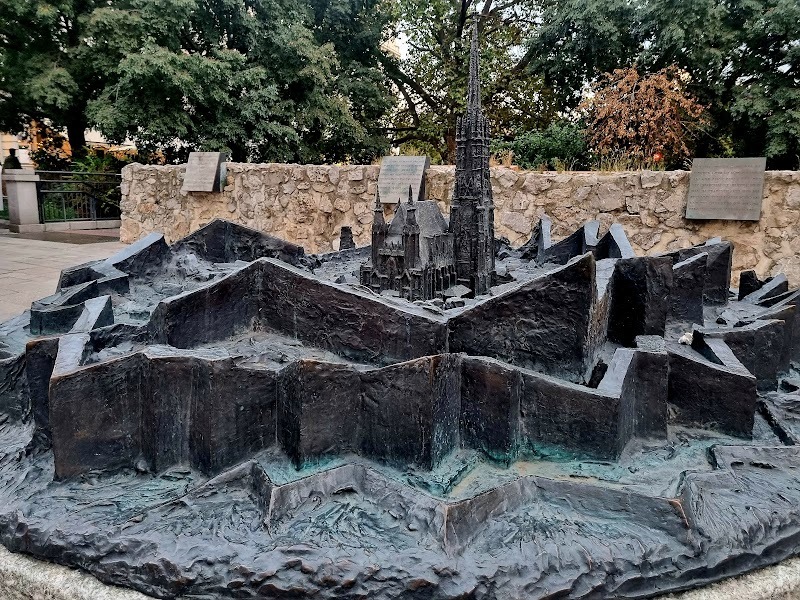
Alte Stadtmauer Stubentor is the preserved remnant of Stubentor, once one of Vienna's principal gates and part of the city's fortified ring. The stones are embedded in the modern streetscape rather than standing as a separate, intact wall. You can see the remains in the open air near Dr.-Karl-Lueger-Platz and inside Stubentor U-Bahn station. The Siege of Vienna 1683 tour visits this stop and places the masonry within the story of the city's defence.
What is Alte Stadtmauer Stubentor?
Alte Stadtmauer Stubentor is what remains of a former city gate on Vienna's eastern boundary. Stubentor was one of Vienna's principal entrances and a vital section of the fortified ring that protected the city. Its surviving stones are not a complete gateway or a continuous wall. They are preserved fragments integrated into the contemporary city, where historic masonry appears beside streets and the underground station.
The remains belong to the Renaissance wall system constructed between 1555 and 1566. That system was built after the traumatic Ottoman siege of 1529, giving the stones a direct connection to the rebuilding and strengthening of Vienna's urban defences.
Why does Stubentor matter in Vienna's fortified history?
Stubentor matters because it shows how Vienna's defensive system functioned during the Second Ottoman Siege of 1683. By then, the Renaissance walls were already more than a century old. Stubentor marked the eastern boundary of a city under siege and formed part of a coordinated network protecting the city.
Most Ottoman assaults concentrated on the western bastions, but the Stubentor area remained under tension. Ottoman sappers dug tunnels beneath the defences, seeking to collapse sections of the wall with explosives. Vienna's defenders responded with countermines and constant vigilance. Stubentor may not have seen the fiercest fighting, but its position as a sealed and fortified gate made it part of the wider defensive system. The open question preserved by the tour belongs to the experience itself; the historical record here does not resolve it for you.
What can you see at the Stubentor wall remnants?
Look for weathered stones preserved in two connected settings: the open-air streetscape near Dr.-Karl-Lueger-Platz and the interior of Stubentor U-Bahn station. Their placement is the defining feature of the site. The masonry does not stand apart as an intact medieval-style wall; it is set within a modern environment of glass, concrete, streets and station infrastructure.
That contrast makes the remains legible as physical traces of a fortified gate and defensive system. They are not merely an abstract reference to Vienna's past. The stones are the surviving material of the wall system that enclosed and defended the city, still integrated into the place where Stubentor once served that function.
How does Alte Stadtmauer Stubentor fit into Austria's walled-town history?
Alte Stadtmauer Stubentor belongs to a wider Austrian history of fortified towns, but its form is distinct: this is a preserved remnant integrated into modern Vienna rather than a town whose walls survive almost intact. The earliest Austrian walled towns began appearing from the late 11th century to the early 13th century. Their development was closely connected with Austria's position as a march of the Holy Roman Empire, including the influence of the Hohenstaufen emperors, marcher lords and the Babenbergs.
Present-day Austria has 106 walled towns or cities. The walls of Radstadt, Freiburg, Hainburg and Drosendorf survive almost intact, while the Stubentor material survives as fragments within an active urban setting. That difference is central to understanding the site: its preserved stones connect a present-day station and streetscape to Vienna's Renaissance fortifications and the siege of 1683.
The tour that visits Alte Stadtmauer Stubentor
Each one is a self-guided route you can start whenever you like.

Vienna · 3h 45m
Siege of Vienna 1683
Step into the drama of 1683 Vienna with this immersive 7 km walking tour! Retrace the city's desperate defense against the Ottoman siege, from St. Stephen's Cathedral to the legendary cannonball in the wall. Explore historic bastions, militia headquarters, museum artifacts, and the fabled arrival of the Winged Hussars. Each stop blends vivid storytelling, real locations, and fascinating trivia. Experience Vienna's most pivotal moment—one cobblestone at a time.
- places
- Vienna
- Stubentor
- city walls
- fortifications
- Austrian history