
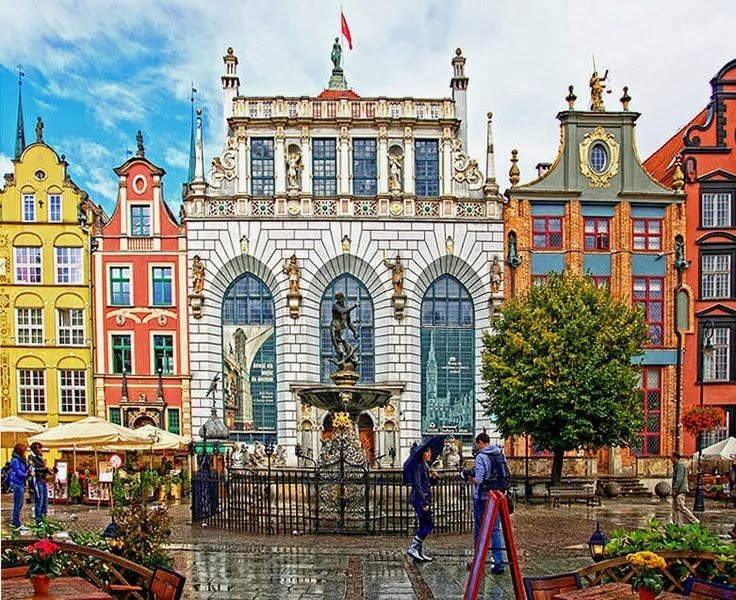
Artus Court is a historic building in the centre of Gdańsk, at Długi Targ 44. Once a meeting place for merchants and a centre of social life, it is now a visitor point of interest and a branch of the Gdańsk History Museum.
What is Artus Court in Gdańsk?
Artus Court was created as a place where Gdańsk’s merchants could meet, conduct business and maintain their social world. Its identity was tied to the city’s commercial elite rather than to the public markets, making the building a particularly direct expression of how merchant life was organised in Gdańsk.
The building remains a named landmark on Długi Targ, where its former role can be understood through the surviving structure and interior. Its present status as a branch of the Gdańsk History Museum gives visitors access to a place that once operated as a working centre of the city’s merchant society.
Why was Artus Court important to Gdańsk’s merchants?
Artus Court served as the primary social and commercial headquarters for Gdańsk’s merchant brotherhoods and local elite. Its hall functioned as a private exchange: international shipping contracts were negotiated there, and maritime insurance was finalised among guild members.
Access was restricted to high-status burghers. That restriction kept major economic decisions within the merchant class and clearly separated Artus Court from the city’s public markets. The court was also divided into “benches”, or sections assigned to particular merchant groups, including the Lübeck bench and Reinhold’s bench.
Those arrangements reflect Gdańsk’s position in Baltic trade. Merchants connected with the Hanseatic League and the English Eastland Company interacted within the hall, while guild arbitration provided a setting for disputes to be settled. The building therefore combined commercial negotiation, social hierarchy and practical conflict resolution in one place. You can explore these functions as part of The Merchant Republic - Gdańsk’s Golden Age (1550-1650).
What can you notice about Artus Court’s architecture and interior?
Artus Court is Gothic in origin, but the facade you associate with the building is Mannerist. Abraham van den Blocke designed the current facade, which was completed in 1617.
Inside, the most distinctive detail is the Renaissance tiled stove. It rises 11 metres and was completed between 1545 and 1546 by Georg Stelzener. Its 520 tiles depict European monarchs and mythological figures, combining decoration with a visual record of the political and economic connections that mattered to the city.
The stove is especially revealing because its imagery reflects Gdańsk’s international alignments. At Artus Court, the interior decoration belongs to the same world as the contracts, insurance agreements and merchant benches: a city whose commercial life reached across the Baltic.
Where can you place Artus Court in Gdańsk’s merchant history?
Artus Court stands at Długi Targ 44 in central Gdańsk, but its historical significance comes from what happened inside rather than from its address alone. It was a restricted merchant exchange, not a public market, and its benches, guild members and arbitration practices gave the building a specific place within the city’s commercial life.
To encounter Artus Court as one stop in that wider story, follow The Merchant Republic - Gdańsk’s Golden Age (1550-1650). The route places the building within Gdańsk’s merchant history while leaving its distinctive facade, benches and Renaissance stove to reward close attention.
The tour that visits Artus Court
Each one is a self-guided route you can start whenever you like.

Gdańsk · 1h 20m
The Merchant Republic — Gdańsk’s Golden Age (1550–1650)
Discover Gdańsk's Golden Age on this immersive walking tour through the Main Town. Explore stunning Flemish Mannerist architecture, legendary merchant halls, and iconic landmarks like the Golden Gate, Artus Court, Neptune's Fountain, and the mighty Crane. Step into the world of 16th–17th century trade, culture, and opulence.
- places
- Gdańsk
- Artus Court
- merchant history
- architecture
- Poland