
Bologna, Italy3 min read
Basilica di San Petronio Bologna: What Makes It Distinctive?
Basilica di San Petronio on Google Maps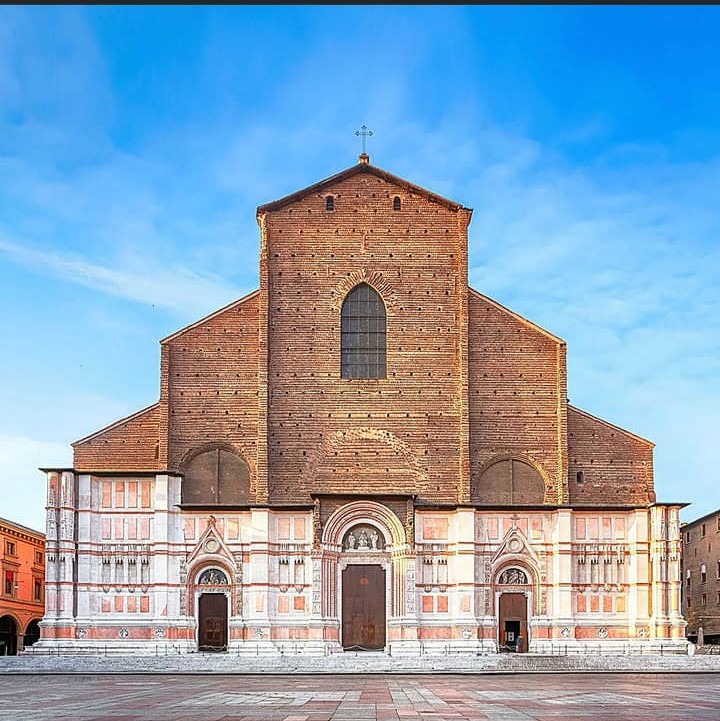
The Basilica di San Petronio in Bologna is a minor basilica and church of the Archdiocese of Bologna in Emilia-Romagna, northern Italy. It dominates Piazza Maggiore and is dedicated to Saint Petronius, Bologna’s patron saint and fifth-century bishop. Construction began in 1390, after the city commissioned the building as a civic temple rather than the church hierarchy commissioning it alone.
That civic origin gives San Petronio an unusual identity: it is a place of religious worship, but also a monument expressing Bologna’s civic character. Its unfinished marble-and-brick façade and its astronomical instrument built into the floor and roof make it one of the city’s most distinctive buildings.
What is the Basilica di San Petronio in Bologna?
The Basilica di San Petronio is Bologna’s monumental church on Piazza Maggiore, dedicated to the city’s patron saint. The city began constructing it in 1390 as a civic temple, creating a direct connection between Bologna’s public identity and religious life.
Its history is therefore not simply the history of a basilica. San Petronio belongs to Bologna’s civic story as much as to its ecclesiastical one, a distinction explored in the Bologna Academic History Tour.
Why is the Basilica di San Petronio unfinished?
The Basilica di San Petronio is unfinished because construction was halted in the 16th century. The lower portion of the main façade is clad in marble, while the upper half remains exposed brick, producing the abrupt contrast that defines the building’s exterior.
Pope Pius IV diverted funds and land intended for the basilica to establish the Archiginnasio for the University of Bologna. This prevented San Petronio from becoming larger than St. Peter’s Basilica in Rome. The building was transferred from the city to the diocese in 1929 and finally consecrated in 1954, but its façade remains incomplete.
What can you find inside the Basilica di San Petronio?
Inside San Petronio, you can find Cassini’s Meridian Line, a scientific instrument that turns part of the basilica into a solar observatory. Astronomer Giovanni Domenico Cassini installed it in 1655.
The bronze line stretches approximately 67 metres along the floor of the left aisle. At 1/600,000th of the Earth’s circumference, it is described in the source as the longest indoor meridian line in the world. A gnomon hole 27 metres high in the roof allows a beam of sunlight to strike the line at local solar noon.
Marble zodiac inlays mark the sun’s position through the seasons. Cassini used the instrument to measure the solar year and provide evidence that Earth’s orbit is elliptical rather than perfectly circular. The observations helped refine the Gregorian calendar and verify Kepler’s laws of planetary motion. The basilica’s Meridian Line is not a decorative detail: it is a working piece of astronomical history integrated into the church itself.
How did San Petronio become connected with Bologna’s patron saint?
San Petronio is dedicated to Saint Petronius, Bologna’s patron saint and a fifth-century bishop of the city. The basilica has housed the relics of Bologna’s patron saint only since 2000. Before then, the relics were preserved in Santo Stefano church.
What makes the Basilica di San Petronio distinctive?
The Basilica di San Petronio brings together three identities in one building: an unfinished civic monument, an active church dedicated to Bologna’s patron saint, and a scientific instrument built into its floor and roof. Its façade records the interruption of a civic project, while Cassini’s Meridian Line records the building’s later role in astronomical observation.
To explore how San Petronio fits into Bologna’s civic, religious and scientific history, follow the Bologna Academic History Tour.
The tour that visits Basilica di San Petronio
Each one is a self-guided route you can start whenever you like.
Bologna · 1h 45m
Bologna Academic History Tour
Journey through Bologna's red-brick heart on an immersive academic history tour! Explore the world's oldest university, marvel at anatomical theatres, scientific marvels, and secret gardens. Discover the legends, inventions, and international spirit that earned Bologna its nickname: 'La Dotta'—The Learned.
- places
- Bologna
- Basilica di San Petronio
- Piazza Maggiore
- Italian landmarks
- astronomy