
Prague, Czech Republic2 min read
Charles Bridge Prague: History, Stones and Statues
Charles Bridge on Google Maps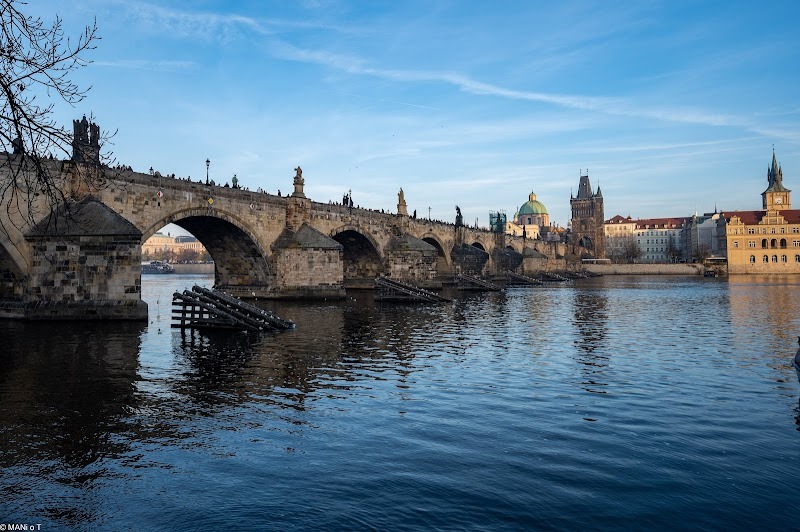
Charles Bridge is a medieval stone arch bridge crossing the Vltava River in Prague, Czech Republic. Construction began in 1357 under the auspices of King Charles IV and finished in the early 15th century, creating the historic crossing now associated with Prague.
The bridge replaced the Judith Bridge, which had been built between 1158 and 1172 and was severely damaged by a flood in 1342. It was originally known as Stone Bridge or Prague Bridge, and the name Charles Bridge has been used since 1870.
Why was Charles Bridge important to Prague's history?
Charles Bridge was important because its crossing over the Vltava became a defensive position as well as a route through Prague. Its sandstone arches were designed for strength as well as beauty, intended to withstand floods and the movement of armies.
That purpose became starkly visible in 1648, during the climactic days of the Thirty Years' War, when Charles Bridge became Prague's last line of defense. Swedish Protestant forces advanced toward Prague Castle and the heart of Bohemia. Catholic defenders and local townspeople fortified the bridge with makeshift barricades, overturned wagons and cannon placements.
The fighting turned the span into a battleground. Musketeers exchanged fire across the parapets, while hand-to-hand combat took place on the bridge's stones. The defenders used their knowledge of the structure as well as their weapons: narrow passages, statues that offered cover and choke points helped them resist the attack. You can explore this wartime setting through Prague & the Thirty Years' War without reducing the bridge to a purely picturesque landmark.
What should you notice on Charles Bridge?
Start with the bridge itself: its medieval stone span, sandstone arches and position directly above the Vltava explain why the crossing mattered both architecturally and strategically. The structure is not just a surface between two riverbanks; its arches are the visible engineering behind a bridge built to endure difficult conditions.
Then look at the statues lining Charles Bridge. Some commemorate saints and martyrs. In the historical account of the 1648 defense, others stand as silent witnesses to the courage and chaos that reached the bridge during the fighting.
The layout also deserves attention. Read the parapets, narrow passages, potential cover and choke points as features of a defensive space rather than only as edges around a scenic viewpoint. These details help explain how the bridge's physical form shaped the resistance. The structure does not tell you the outcome by itself, but it shows why control of the crossing mattered.
How can you experience Charles Bridge as more than a landmark?
Cross Charles Bridge while paying attention to its defensive geometry, its statues and its position over the Vltava. Then use the Prague & the Thirty Years' War route to examine the bridge's 1648 history through its role in Prague's resistance, keeping the focus on the details that remain built into the crossing itself.
The tour that visits Charles Bridge
Each one is a self-guided route you can start whenever you like.

Prague · 1h 40m
Prague & the Thirty Years’ War
Relive the drama of the Thirty Years' War on this immersive outdoor tour of Prague. Walk from the infamous Defenestration window at Prague Castle through secretive Malá Strana streets, across the iconic Charles Bridge, and into the heart of Old Town Square. Uncover tales of rebellion, religious strife, and cultural suppression at each landmark, with plaques, hidden markers, and stunning architecture bringing 17th-century Prague to life. Perfect for history lovers and curious explorers.
- places
- Prague
- Charles Bridge
- Czech Republic
- Thirty Years' War
- Prague history