
Paris, France3 min read
Domaine National du Palais-Royal: A Royal Courtyard in Buren’s Stripes
Domaine National du Palais-Royal on Google Maps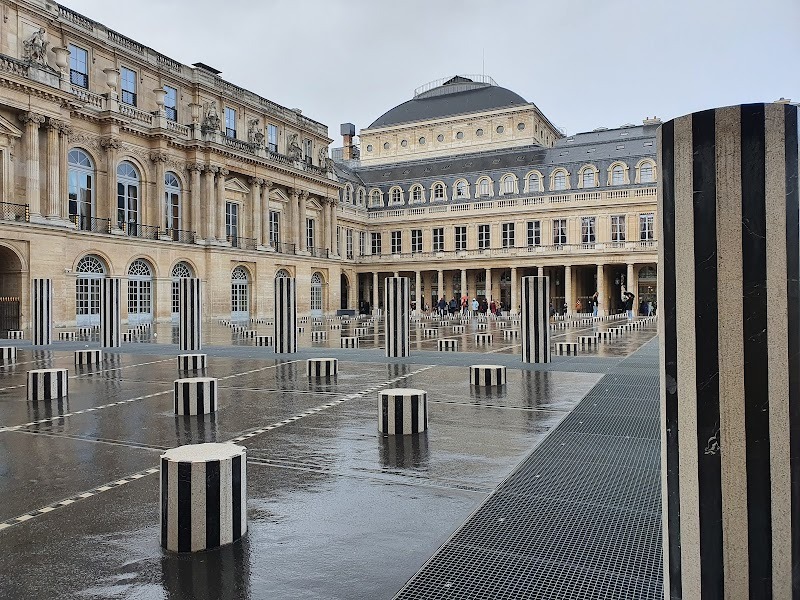
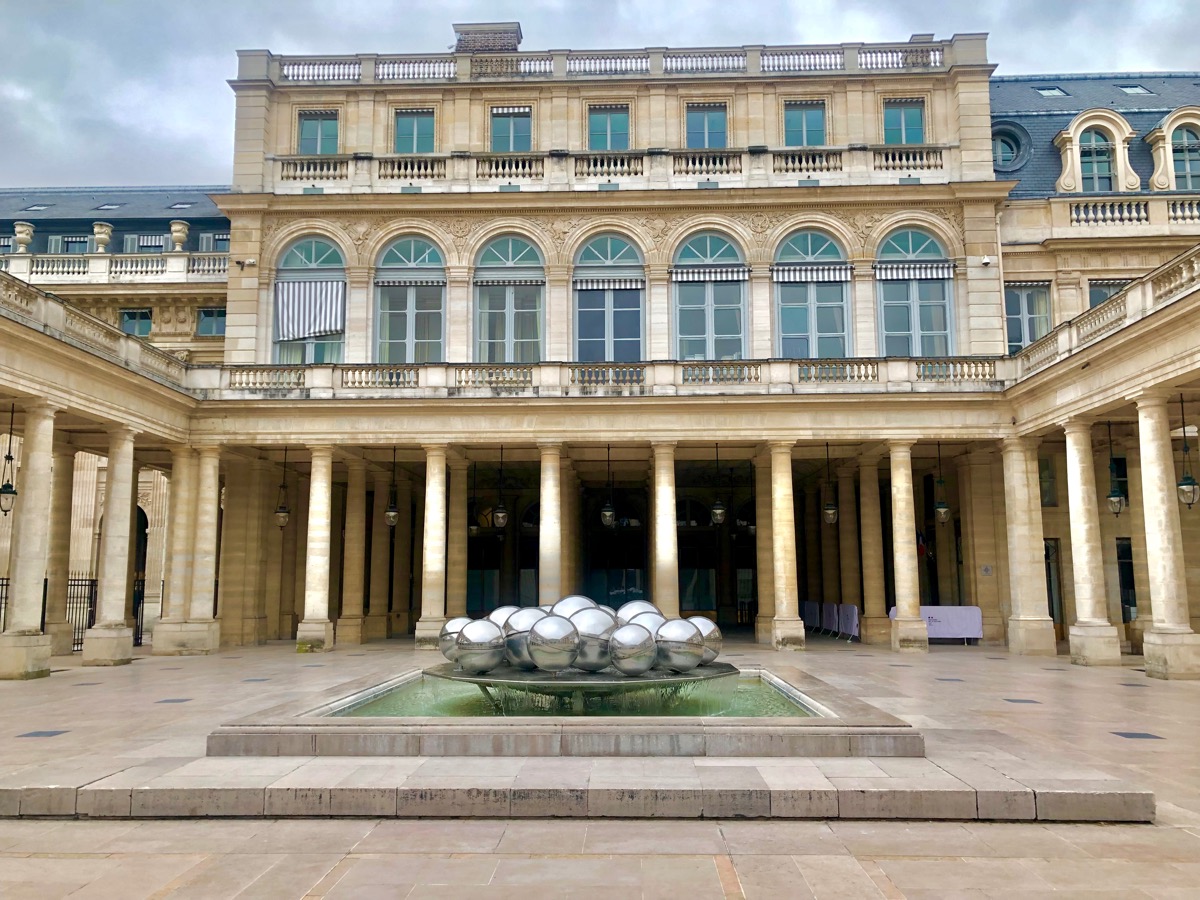
The Domaine National du Palais-Royal is a former French royal palace on Rue Saint-Honoré in Paris’s 1st arrondissement. Its screened entrance court faces the Place du Palais-Royal, directly opposite the Louvre, while its historic courtyard is marked by Daniel Buren’s black-and-white striped columns.
The location makes the palace easy to identify: look across the Place du Palais-Royal from the Louvre for the screened court and the entrance to the complex. The site is also stop 1 of 10 on the Paris Fashion History tour, which connects it with several fashion landmarks elsewhere in Paris.
What is the Domaine National du Palais-Royal?
It is a former French royal palace whose entrance court faces the Louvre across the Place du Palais-Royal. The palace stands on Rue Saint-Honoré, in the 1st arrondissement, and its screened entrance gives the complex a clearly defined relationship with the square outside.
That position is part of what makes the site distinctive. The palace is not simply near the Louvre; its entrance court faces it directly, placing a royal residence and one of Paris’s best-known museum buildings in the same urban view.
What is the history of the Palais-Royal?
The site began as the Palais-Cardinal, built for Cardinal Richelieu from about 1633 to 1639. Jacques Lemercier was the architect, and Richelieu later bequeathed the palace to Louis XIII.
Louis XIV subsequently gave it to his younger brother, Philippe I, Duke of Orléans. The succeeding Dukes of Orléans made extensive alterations over the years, so almost nothing of Lemercier’s original design remains. The building’s identity therefore comes from a succession of royal and aristocratic associations rather than from an untouched seventeenth-century plan.
What should you look for in the Palais-Royal courtyard?
Look for Les Colonnes de Buren, also known as Les Deux Plateaux, the contemporary installation that gives the courtyard its unmistakable character. French artist Daniel Buren installed it in 1986.
The work consists of black-and-white striped columns in varying heights. Their repeated pattern and changing scale create a visually contrasting landscape against the surrounding historical architecture. The columns rise from the ground across the courtyard, turning the space into something visitors can explore, photograph, sit on, or stroll among.
That makes the installation a useful meeting point when you are planning Paris with someone else: instead of sending only a vague location, tell your companion to look for the striped columns inside the historic palace courtyard. The detail is specific enough to recognise and gives both of you something to notice on arrival.
How does the Palais-Royal connect Parisian history and contemporary art?
The contrast is physical rather than abstract. A place that began as the Palais-Cardinal, passed to Louis XIII, and later became associated with the Dukes of Orléans now contains Buren’s modern field of striped columns. The installation does not erase the palace’s history; it makes the historic architecture around it more apparent by setting it against a sharply contemporary form.
When you visit, focus on that relationship: the screened court and palace setting establish the site’s royal identity, while Les Deux Plateaux supplies its modern, interactive presence. Visit the courtyard to see the contrast for yourself, or use the Paris Fashion History tour to make this landmark one stop in a wider Paris walk.
The tour that visits Domaine National du Palais-Royal
Each one is a self-guided route you can start whenever you like.
Paris · 1h 50m
Paris Fashion History - Louis Vuitton, Goyard, Place Vendôme, Chanel, Hermès
You have embarked on a fascinating journey through the origins of modern fashion, tracing its roots back to when Charles Worth established the first fashion house in Paris in the mid-19th century. Th…
- places
- Paris
- Palais-Royal
- French history
- contemporary art
- city exploration