
New York, NY, United States2 min read
Federal Reserve Bank of New York: Why 33 Liberty Street Matters
Federal Reserve Bank of New York on Google Maps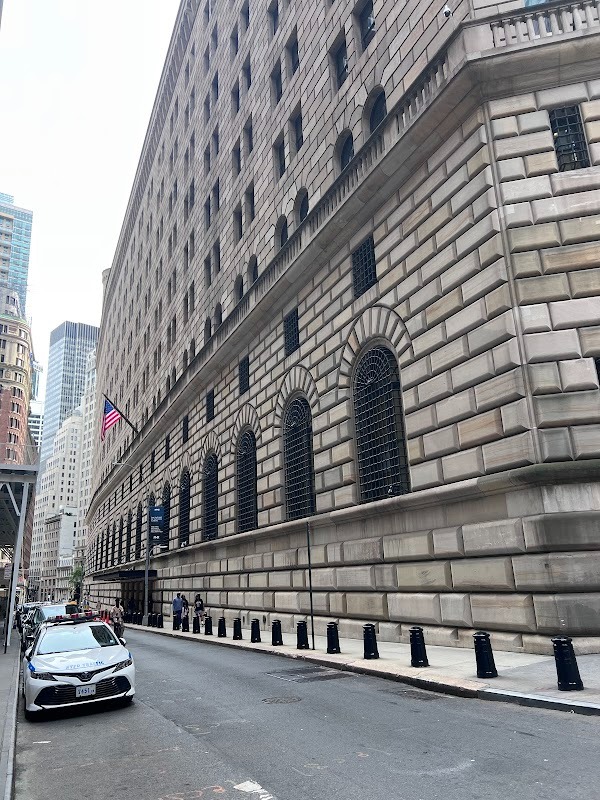
The Federal Reserve Bank of New York is one of the twelve Federal Reserve Banks of the United States. Its building at 33 Liberty Street in Lower Manhattan is also home to one of the world's largest gold vaults, making this institution more than an imposing address in New York's financial district.
What is the Federal Reserve Bank of New York?
The New York Fed is the Federal Reserve Bank responsible for the Second District of the Federal Reserve System. That district includes New York State, the 12 northern counties of New Jersey, Fairfield County in Connecticut, Puerto Rico, and the U.S. Virgin Islands.
Within the Federal Reserve System, it is the largest, most active, and most influential of the Reserve Banks. Its location at 33 Liberty Street places it in Lower Manhattan, beside the nation's primary financial markets. That position helps explain why the institution has an importance extending well beyond its immediate district.
Why was the Federal Reserve Bank of New York established?
The bank was established after the Panic of 1907 and the creation of the Federal Reserve System in 1913. Its purpose included stabilizing financial markets, regulating banking liquidity, and reducing the risk of severe financial panics that had repeatedly shaken the American economy during the late 19th century.
Lower Manhattan was a significant location for that mission because it placed the institution directly beside the nation's primary financial markets. The address connects the bank's history to the financial activity that the Federal Reserve System was created to help manage.
What is beneath 33 Liberty Street?
Deep beneath street level, the building houses one of the world's largest gold vaults. Its reinforced chambers store gold reserves belonging to governments and central banks from around the world.
That vault is the most distinctive physical feature associated with 33 Liberty Street. It gives the address a concrete connection to the international monetary system: the building is not only an office for financial policy, but also a guarded location for reserves held on behalf of governments and central banks.
Why does the New York Fed matter beyond its vault?
The institution's responsibilities extend beyond gold storage to monetary policy, market operations, treasury transactions, and international finance. Those roles make the New York Fed central to how financial markets and the wider monetary system operate.
Its importance became especially visible during major economic shocks. The institution was central to efforts to stabilize markets during the Great Depression, the 2008 financial collapse, and the COVID-19 economic shock. To place 33 Liberty Street in that wider financial history, take the Wall Street and NYSE history tour, which includes the bank in its Lower Manhattan context.
To explore this landmark through that financial history, start the Wall Street and NYSE history tour.
The tour that visits Federal Reserve Bank of New York
Each one is a self-guided route you can start whenever you like.

New York, NY · 1h 25m
The History of Wall Street & the NYSE — New York Tour
Explore the thrilling evolution of Wall Street, from its humble beginnings beneath a buttonwood tree to its reign as the world's financial capital. This immersive self-guided tour takes you to iconic sites like the NYSE, Federal Hall, the Charging Bull, and more. Uncover scandals, legends, and the dramatic stories behind the rise of American finance on the streets that built global capitalism.
- places
- New York, NY
- New York
- Lower Manhattan
- Federal Reserve
- Wall Street