
Washington, D.C., United States3 min read
Federal Triangle Washington, D.C.
Federal Triangle on Google Maps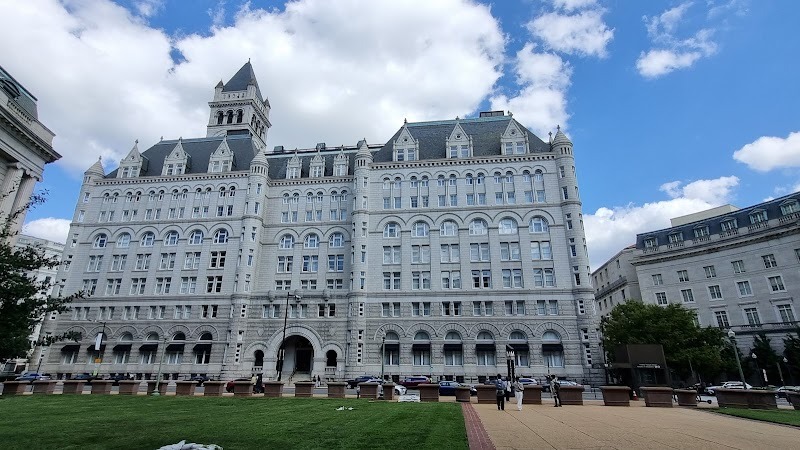
Federal Triangle is a triangular area in Washington, D.C., bounded by 15th Street NW, Constitution Avenue NW, Pennsylvania Avenue NW, and E Street NW. It contains 10 large city and federal office buildings, all part of the Pennsylvania Avenue National Historic Site. Its buildings and layout reveal how the U.S. federal government expanded into a more centralized, professional administrative state.
What is Federal Triangle in Washington, D.C.?
Federal Triangle is a specific government district rather than a general description of central Washington. Its four boundaries are 15th Street NW, Constitution Avenue NW, Pennsylvania Avenue NW, and E Street NW. Within that triangle stand 10 large city and federal office buildings, unified as part of the Pennsylvania Avenue National Historic Site.
The district's position is significant: it is positioned between the Capitol and the White House, placing a concentrated group of federal institutions within the capital's central governing landscape. The buildings are not separate landmarks assembled by chance; together, they form a coordinated office complex.
How did Federal Triangle develop?
Federal Triangle emerged during the 1920s and 1930s as one of the largest federal construction projects in American history. Seven buildings were constructed by the U.S. federal government in the early and mid-1930s as part of a coordinated construction plan described as one of the greatest building projects ever undertaken.
The plan consolidated numerous government agencies into monumental office buildings positioned between the Capitol and the White House. Two buildings that predated the coordinated effort were incorporated into Federal Triangle, and one additional building was constructed in the 1990s. The result was a district shaped by multiple stages of federal construction but organized around a single institutional purpose.
That purpose reflected the changing responsibilities of the federal government. The district's development corresponded with the Progressive Era, the New Deal, industrialization, economic crises, global wars, and international diplomacy. As those forces expanded the federal state's responsibilities, Washington required a larger professional bureaucracy to manage national economic policy, wartime mobilization, intelligence, regulation, and public administration. The Washington DC: Power & Institutions Tour places Federal Triangle within that broader story of American governance.
What does Federal Triangle’s architecture represent?
Federal Triangle's architecture combines neoclassical and Art Deco influences to project order, efficiency, and institutional authority. Massive limestone facades, ceremonial avenues, monumental sculptures, and repetitive geometric forms give the district a deliberately unified visual language.
That visual language was suited to the work carried out inside the complex. The buildings and their layout were intended to communicate bureaucratic stability and centralized governance. Their scale and repetition turn administration into a physical presence: government is represented not as one office, but as a coordinated system of institutions.
Agencies associated with Federal Triangle included the Department of Commerce, the Internal Revenue Service, the Department of Justice, and later the FBI. Those institutions illustrate the widening reach of federal administration across commerce, taxation, labor, infrastructure, and public administration.
Why does Federal Triangle matter in Washington, D.C.?
Federal Triangle matters because it became the physical embodiment of the expansion of the federal administration. Its buildings preserve the connection between major twentieth-century changes in government and the spaces created to house them.
The district's location between the Capitol and the White House reinforces its connection to national governance, while its agencies show what that governance increasingly involved: regulating commerce, collecting taxes, managing infrastructure, administering public programs, and responding to crises at home and abroad. For a more connected view of those institutions, the Washington DC: Power & Institutions Tour includes Federal Triangle as stop 6 of 8.
The tour that visits Federal Triangle
Each one is a self-guided route you can start whenever you like.

Washington, D.C. · 2h 15m
Washington DC: Power & Institutions Tour
Explore the iconic heart of Washington DC on this immersive self-guided tour. Walk through the power corridors of Congress, the White House, the Supreme Court, and more. Uncover the secrets, history, and drama behind America's most influential institutions—perfect for history buffs, curious travelers, and anyone fascinated by the machinery of democracy.
- places
- Washington, D.C.
- Federal Triangle
- Washington D.C.
- U.S. federal government
- Washington landmarks
- American government