
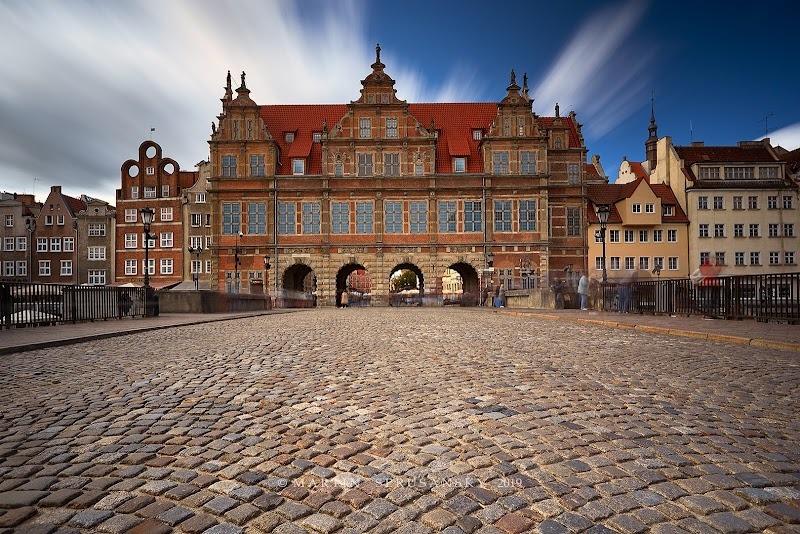
Green Gate, also known as Brama Zielona, is one of Gdańsk's notable tourist attractions. It stands between Long Market and the River Motława, forming a gateway between the city's representative centre and its riverfront.
That setting explains why Green Gate is more than a passage through the city. Its position joins Long Market, the administrative and ceremonial heart of Gdańsk, with the working waterfront beside the Motława.
What is Green Gate in Gdańsk?
Green Gate is a gateway building between Long Market and the River Motława. Its four archways made it a practical connection between the centre of Gdańsk and the port, while its appearance gave that connection a distinctly monumental character.
The building's location also placed it on the Royal Route, the ceremonial route through the city. Green Gate acted as the route's final checkpoint, linking political display with the industrial waterfront.
Why was Green Gate built?
Green Gate was constructed between 1564 and 1568 to replace the 14th-century Kogi Gate. Regnier van Amsterdam and Hans Kramer designed it in the Dutch Mannerist style, giving the structure a more elaborate architectural identity than a basic defensive entrance.
Its intended purpose was also unusually prestigious: Green Gate was planned as a royal residence for visiting Polish monarchs. It was rarely used for that purpose, however, and its four archways became more important as a busy route between the Long Market and the Motława riverfront.
What makes Green Gate's architecture unusual?
Green Gate's architecture reflects Gdańsk's trading connections through the materials used to build it. The structure uses imported Dutch brick, which was smaller than local Baltic brick. The brick arrived as ballast on trade ships returning from the Netherlands, demonstrating direct logistical ties between Gdańsk and Flanders.
Look at the contrast between the building's elaborate stonework and large windows and the defensive role usually associated with a city gate. These details mark a shift toward representational architecture rather than a purely defensive structure. The four archways remain the defining physical feature: they make the building read as both an impressive façade and a working urban passage.
How did Green Gate connect Gdańsk's centre with the port?
The four archways formed a high-traffic passage between Long Market and the Motława riverfront. This made Green Gate useful to the city council, which could monitor goods and officials moving between the administrative heart of Gdańsk and the industrial wharves of the port.
For a time, the ground floor housed the city's official weighing scales. Incoming goods could be weighed and recorded there for taxation, giving the gateway a practical role in the movement of commerce as well as a ceremonial one.
What should you look for at Green Gate?
Start with the relationship between the four archways, Long Market and the Motława. Then notice how the large windows and elaborate stonework challenge the usual image of a defensive gate. Green Gate was designed to represent the city's status as well as to control movement through it.
The Dutch brick offers another clue. Its smaller size and route into Gdańsk as ballast on returning trade ships connect the building's physical fabric to the commercial networks that supported the city. For the place in its wider Golden Age setting, follow The Merchant Republic - Gdańsk's Golden Age (1550-1650), where Green Gate appears as stop 5 of 8.
The tour that visits Green Gate
Each one is a self-guided route you can start whenever you like.
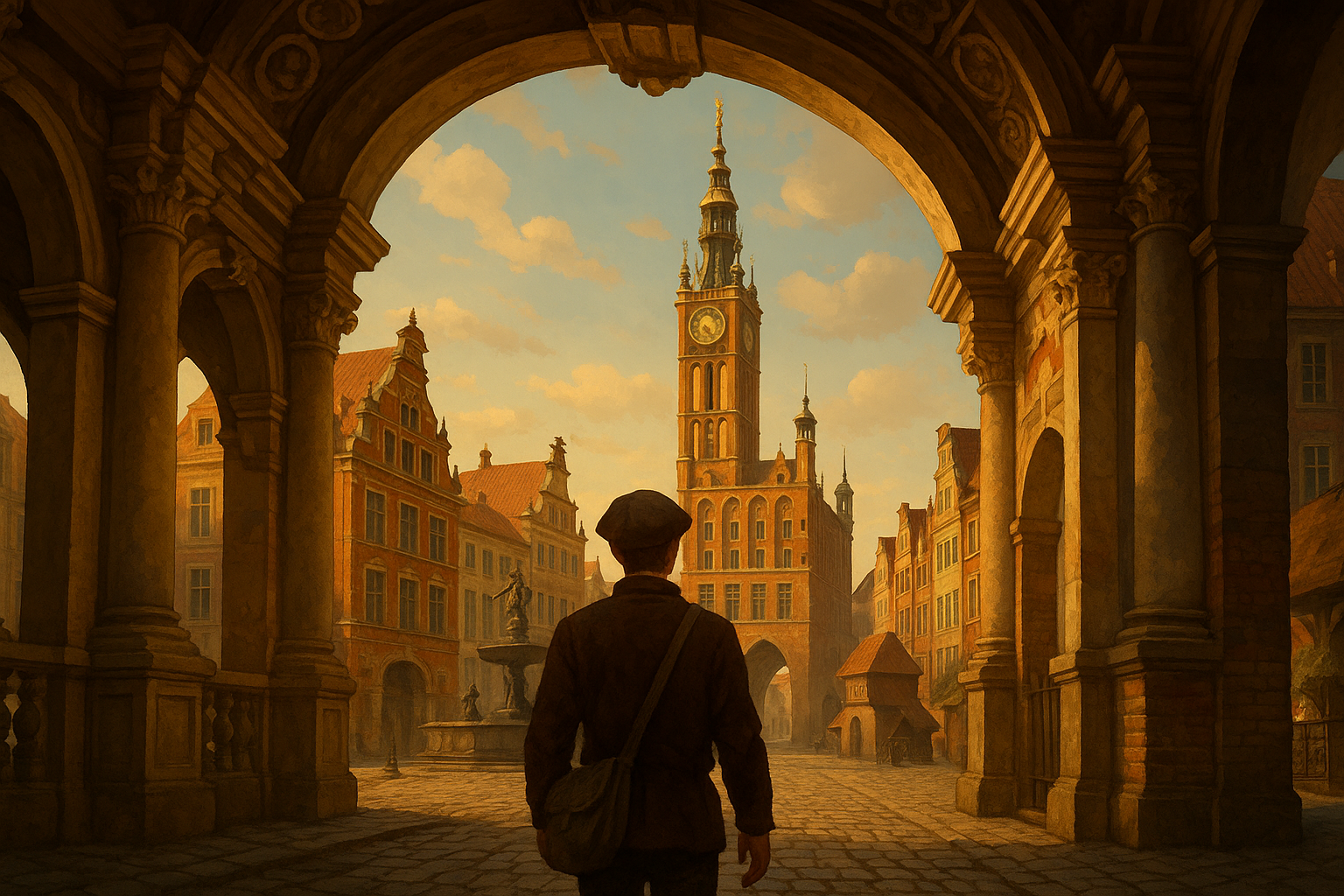
Gdańsk · 1h 20m
The Merchant Republic — Gdańsk’s Golden Age (1550–1650)
Discover Gdańsk's Golden Age on this immersive walking tour through the Main Town. Explore stunning Flemish Mannerist architecture, legendary merchant halls, and iconic landmarks like the Golden Gate, Artus Court, Neptune's Fountain, and the mighty Crane. Step into the world of 16th–17th century trade, culture, and opulence.
- places
- Gdańsk
- Green Gate
- Brama Zielona
- Gdańsk history
- Dutch Mannerist architecture