
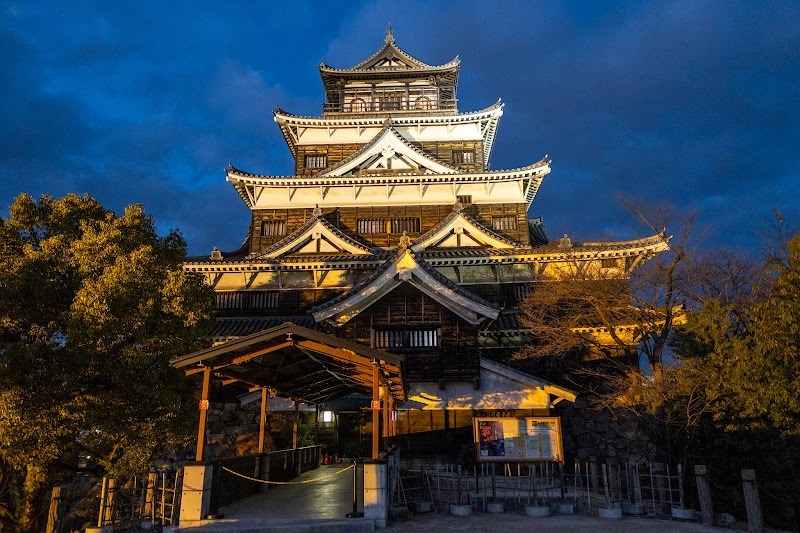
Hiroshima Castle is a strikingly reconstructed fortress in the heart of Hiroshima. Originally built by the warlord Mori Terumoto in 1589, it served as the political and military center of the region before its destruction in 1945 and later reconstruction.
What is Hiroshima Castle?
Hiroshima Castle was a feudal stronghold designed to command authority as well as defend the region. Mori Terumoto established it in 1589, and the castle became the political and military center of Hiroshima. Its position and scale reflected the power concentrated inside its walls, where clan rivalries, samurai intrigue and the decisions of feudal government shaped the surrounding territory.
During the Edo period, the keep stood above the city surrounded by three defensive moats. Those moats were not decorative: they show the strategic importance of Hiroshima Castle and the layers of protection built around its central keep.
What happened to the original Hiroshima Castle?
The original Hiroshima Castle was destroyed by the atomic bomb in 1945. The event formed part of the atomic bombings of Hiroshima and Nagasaki on 6 and 9 August 1945, when the United States detonated an atomic bomb over each Japanese city during the final days of World War II.
At Hiroshima Castle, the destruction left the stone foundations as physical witnesses to what happened. They mark a direct break between the feudal structure that once dominated the city and the reconstructed fortress that stands there today. The foundations therefore matter as more than remnants: they are the surviving material connection to the castle before 1945.
What can you see inside Hiroshima Castle today?
The rebuilt castle houses a museum focused on Hiroshima's earlier history. Inside, you can find samurai armor, ancient swords and maps tracing the city's transformation from a warrior's bastion to a beacon of peace.
The reconstructed fortress has wooden walls and elegant roofs that evoke the form of the earlier castle. They should be read as a reconstruction rather than as surviving original fabric: the stone foundations are the physical witnesses that remain from the destroyed structure. Together, the rebuilt keep and those foundations make the site's history unusually visible, placing the castle's feudal identity alongside the city's later renewal.
The Hiroshima War and Peace route uses the castle as one of its places for connecting these layers of the city's history, from the samurai stronghold to the postwar city represented by the museum's maps.
What should you look for from the keep?
As you ascend the keep, look out over the Hiroshima cityscape and notice how the view joins two different histories: the castle's former role as a warrior stronghold and the renewal of the city after its destruction. From above, look for the defensive moats that once reinforced Hiroshima Castle's strategic position.
The castle's reconstructed form, surviving stone foundations and elevated view work together as details of one place rather than separate attractions. To explore that context through a self-guided route, visit the Hiroshima - War & Peace - Memorial, History, and Cultural tour.
The tour that visits Hiroshima Castle
Each one is a self-guided route you can start whenever you like.

Hiroshima · 1h 50m
Hiroshima - War & Peace - Memorial, History, and Cultural tour
Walk through Hiroshima's living history on this immersive one-day tour. Explore the Peace Memorial Museum, poignant memorials, and the iconic Atomic Bomb Dome. Take in sweeping city views from Orizuru Tower, find serenity at Gokoku Shrine and Hiroshima Castle, and reflect in the tranquil Shukkeien Gardens. Experience stories of tragedy, resilience, and hope at every step.
- places
- Hiroshima
- Hiroshima Castle
- Japanese history
- samurai history
- postwar renewal