
Washington, D.C., United States2 min read
Library of Congress Washington, D.C.
Library of Congress on Google Maps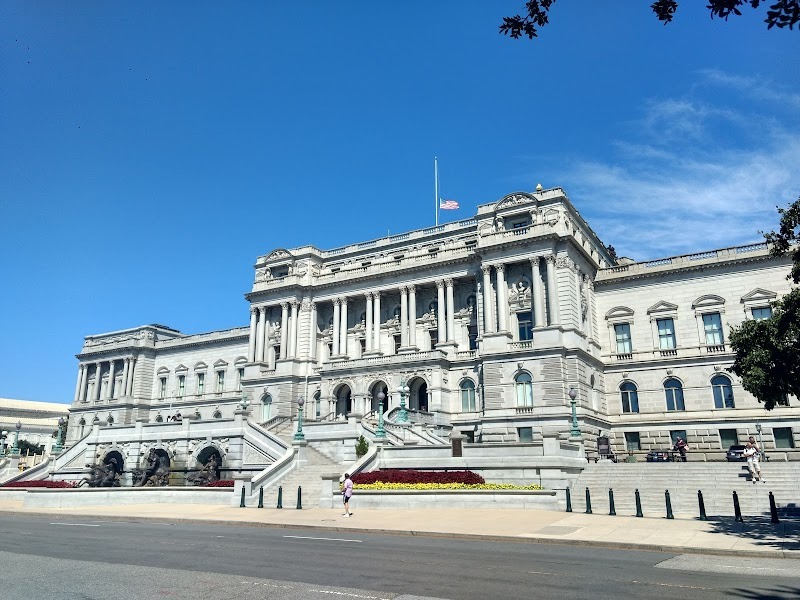
The Library of Congress in Washington, D.C., is the research library and research service for the United States Congress, and it functions as the de facto national library of the United States. It also administers copyright law through the United States Copyright Office and houses the Congressional Research Service. Its growth made it the largest library in the world and an important repository of human knowledge.
What is the Library of Congress in Washington, D.C.?
The Library of Congress serves Congress while preserving knowledge on a national and global scale. Its role is larger than a legislative reference collection: the institution became essential to the functioning of Congress while also serving scholars and researchers worldwide. That combination gives it a distinctive place in American public life, connecting the practical work of government with the preservation and study of human knowledge.
How did the Library of Congress become what it is today?
The institution was founded in 1800 to support the legislative needs of Congress. Its early collection was destroyed when the British burned the Capitol during the War of 1812, forcing the congressional library to be rebuilt.
Thomas Jefferson helped determine what the rebuilt institution could become. He sold his personal book collection to the government, replacing the destroyed library and broadening its intellectual scope beyond law and politics. The Library of Congress consequently developed into an institution that supported Congress while reaching across subjects, cultures, and forms of knowledge. Its history is therefore not only a story of expansion, but also of a changing idea of what a national library should contain.
What makes the Jefferson Building worth noticing?
Completed in 1897, the Jefferson Building gives the Library of Congress a physical expression of its ambitions. Its lavish interiors include murals, mosaics, sculptures, and marble staircases. The decoration celebrates science, literature, philosophy, and artistic achievement, presenting these fields as central to the institution's purpose.
The architecture treats knowledge as a pillar of national power and democratic government. The building is both a working research institution and a symbolic monument to intellectual progress. Its design links the everyday work of studying and supporting legislation with the broader belief that science, literature, philosophy, and art strengthen public life.
What does the Library of Congress preserve?
The Library of Congress preserves manuscripts, maps, recordings, photographs, newspapers, films, and rare books. Among its notable holdings are a Gutenberg Bible, Jefferson's original library collection, presidential papers, and millions of archival materials tied to legislation, diplomacy, war, science, and culture.
Together, these materials document both American and global history in forms that extend far beyond printed books. They show why the Library of Congress matters as a research institution: its collections preserve the records, images, sounds, and texts through which political decisions, cultural achievements, scientific developments, and international events can be studied. To place the institution within Washington's wider civic landscape, explore the Washington DC: Power & Institutions Tour.
The tour that visits Library of Congress
Each one is a self-guided route you can start whenever you like.

Washington, D.C. · 2h 15m
Washington DC: Power & Institutions Tour
Explore the iconic heart of Washington DC on this immersive self-guided tour. Walk through the power corridors of Congress, the White House, the Supreme Court, and more. Uncover the secrets, history, and drama behind America's most influential institutions—perfect for history buffs, curious travelers, and anyone fascinated by the machinery of democracy.
- places
- Washington, D.C.
- Library of Congress
- American history
- architecture
- cultural institutions