
New Orleans, LA, United States2 min read
Madame John's Legacy, New Orleans, LA
Madame John's Legacy on Google Maps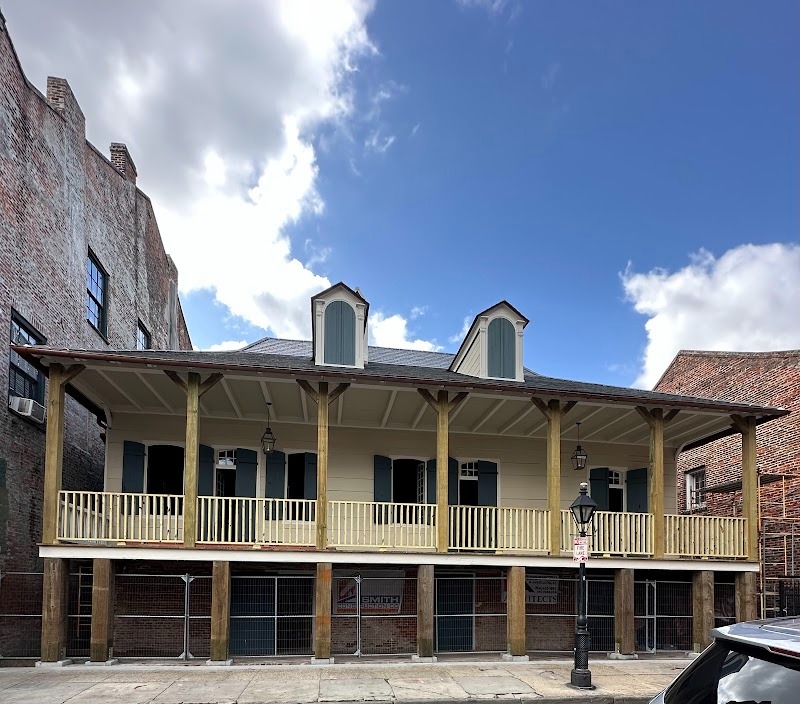
Madame John's Legacy is a historic house museum at 632 Dumaine Street in New Orleans' French Quarter. Completed in 1788, it is one of the oldest houses in the Quarter, built in the older French colonial style that was still prevalent in New Orleans at the time. The Louisiana State Museum owns the house and provides tours; admission is free. Its architectural significance earned it National Historic Landmark status in 1970.
What makes Madame John's Legacy distinctive?
Madame John's Legacy is a rare specimen of French colonial architecture, with a combination of details that gives the house its distinct identity. The building has thick brick walls, a steep hip roof, wrought-iron balconies, an arched doorway, and a shaded courtyard.
The house is also described as a survivor of the catastrophic French Quarter fires of 1788 and 1794. The tour material refers to the building as dating from circa 1794, while the published background identifies it as completed in 1788. Both sources establish its connection to the late-18th-century French colonial architecture of New Orleans without treating the tour's circa-1794 wording as a replacement for the documented completion date.
What can you notice at 632 Dumaine Street?
Start with the arched doorway at 632 Dumaine Street: it is the approach that introduces the house's historic character. Look upward from there to examine the wrought-iron balconies and their curling forms, described in the tour material as the signature of a long-forgotten artisan.
The thick brick walls and steep hip roof are not incidental decoration; they are visible expressions of the house's construction. The shaded courtyard is another defining part of Madame John's Legacy, giving the building a specific spatial character within the French Quarter. The New Orleans French Quarters Tour includes Madame John's Legacy as stop 6 of 9, so you can use the interactive route to place these details within a wider walk without reducing the house to a passing view.
What does Madame John's Legacy reveal about New Orleans life?
Madame John's Legacy connects architecture with the social history of domestic life in New Orleans. The tour material evokes Creole families hosting soirées, ships arriving from France, cookware in use, and conversations around plaçage.
That account also acknowledges the enslaved cooks, maids, and gardeners whose labor supported household life. Plaçage is described as a set of unofficial unions between European men and free women of color. The reference matters because it links the house's domestic world to questions of race, class, and power in New Orleans, rather than presenting Madame John's Legacy only as an attractive architectural relic.
How should you approach a visit to Madame John's Legacy?
Go to 632 Dumaine Street in the French Quarter and focus on the features that make this house specific: the arched doorway, thick brickwork, steep roofline, wrought-iron balconies, and shaded courtyard. For a more interactive way to examine the stop and its historical context, follow the New Orleans French Quarters Tour while you explore the house's place in the Quarter.
The tour that visits Madame John's Legacy
Each one is a self-guided route you can start whenever you like.

New Orleans, LA · 1h 45m
New Orleans French Quarters Tour
Experience New Orleans like never before on this immersive walking tour through the French Quarter. Journey from the soulful Congo Square to the historic French Market, uncovering the city's complex history of slavery, Creole culture, and resilience. Explore iconic landmarks, hidden slave quarters, and vibrant marketplaces, all while hearing stories of struggle, survival, and celebration. Perfect for history buffs and curious travelers alike!
- places
- New Orleans, LA
- Madame John's Legacy
- New Orleans
- French Quarter
- historic houses
- French colonial architecture