
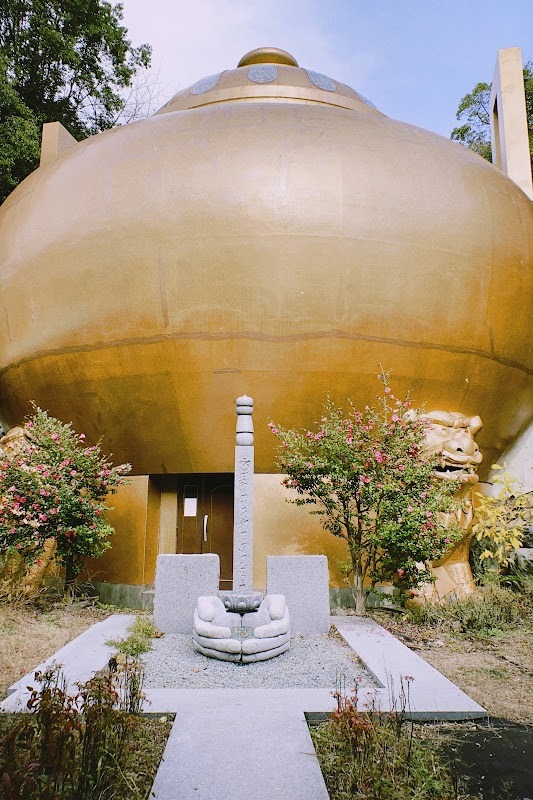
風土記の丘 マントーラ is a hillside sanctuary and living-museum-like attraction on the verdant slopes of Matsuyama. Its setting is associated with Japan’s Kofun period, described in the source as circa the 5th–6th centuries CE, with grassy mounds linked to Yamato-era chieftains and Kofun burial sites.
The historical setting and the local legends are deliberately intertwined here. The source describes the mounds as more than burial sites in local lore, with stories claiming they may be stasis pods for celestial visitors preserving secrets for future generations. That cosmic interpretation is folklore, not established history, but it is central to the distinctive character of Mantora.
What is 風土記の丘 マントーラ?
風土記の丘 マントーラ is a Matsuyama attraction built around a hillside landscape of grassy Kofun-associated mounds, ancient imagery, and playful spiritual mythology. The place connects the physical traces associated with the Kofun period to stories of Yamato-era leaders, celestial visitors, and portals between realms.
Its living-museum-like quality comes from the way the setting is presented through objects and symbols rather than through a single historical explanation. Mantora holds the atmosphere of an ancient site while allowing local legend to remain visible alongside the historical associations.
What can you look for at 風土記の丘 マントーラ?
The winding paths across the hillside are the key way to read the attraction’s details in context. Look for the grassy mounds first, then the haniwa clay figures described in the source. Some take the form of warriors, while others are dancers; their sentinel-like presence connects the paths to the Kofun burial-site setting.
The most enigmatic relic is the tiger-shaped stone. Its unusual form gives Mantora a physical symbol around which much of the local folklore gathers. Tanuki, described as mischievous raccoon-dog tricksters, also belong to the place’s playful atmosphere and are said in local lore to lead people toward hidden secrets or appear in photographs. They are part of the story, not a guaranteed encounter.
What does the name Mantora mean?
The source describes “Mantora” as a fusion of “Mantra” and “Tiger.” In local lore, the name honours a celestial tiger believed to guard temple portals between realms.
The tiger-shaped stone is likewise said, according to legend, to act as a cosmic compass guiding seekers toward enlightenment. That role is a mythic interpretation rather than a confirmed historical function. Together, the name and the stone express Mantora’s blend of ancient remains, spiritual imagery, and playful cosmic myth.
How should you experience 風土記の丘 マントーラ?
Use the winding paths to examine the mounds, haniwa, and tiger-shaped stone as parts of the same hillside setting. 風土記の丘 マントーラ is most distinctive when its Kofun-period associations and local cosmic legend are encountered together, without confusing folklore with established history.
The place is included as stop 3 of 10 in the Matsuyama mysteries tour, offering an interactive way to encounter Mantora alongside the route’s other discoveries.
The tour that visits 風土記の丘 マントーラ
Each one is a self-guided route you can start whenever you like.
Matsuyama · 2h 45m
Matsuyama mysteries
Unravel the enchanting mysteries of Matsuyama on a one-day walking tour! Explore ancient temples, mystical tunnels, vibrant shrines, and Japan's oldest hot spring. Savor local flavors, marvel at animated clocks, and conquer Matsuyama Castle for stunning city views. Adventure, legends, and laughter await in every step of this immersive solo journey.
- places
- Matsuyama
- 風土記の丘 マントーラ
- Mantora
- Kofun period
- Japan travel