
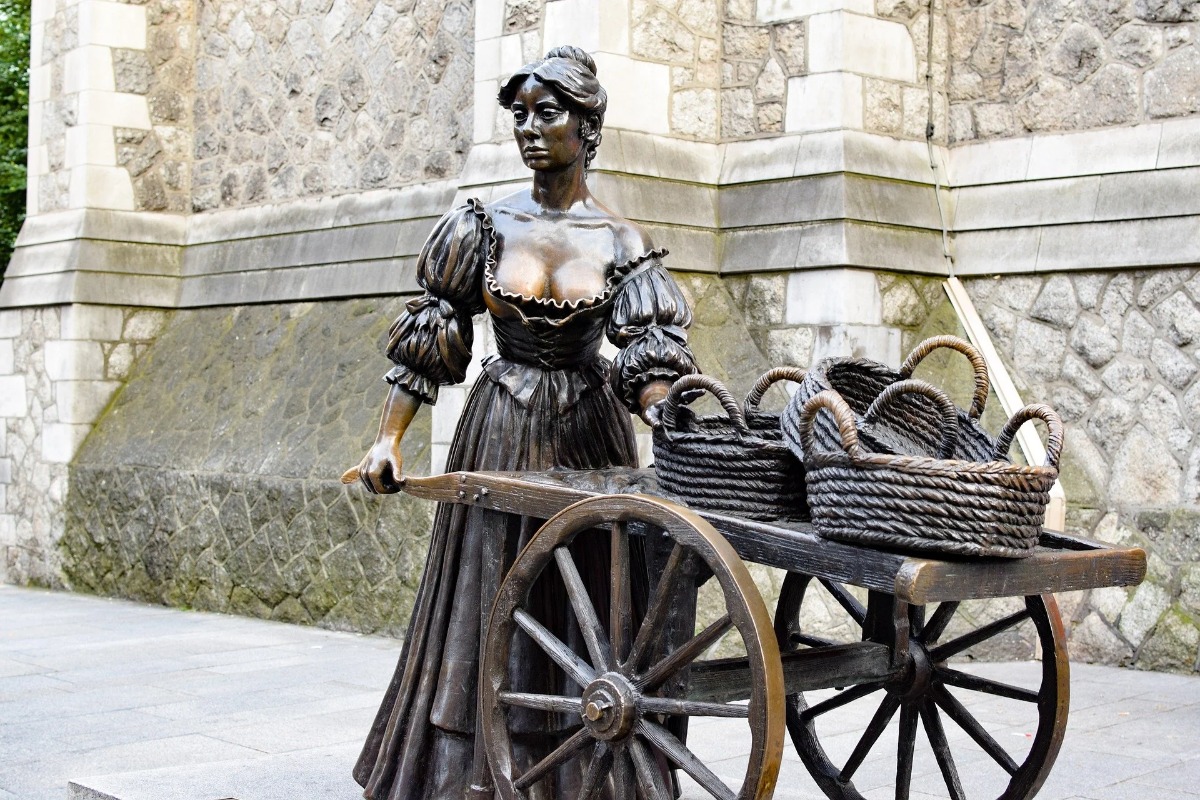
The Molly Malone Statue Dublin landmark depicts Molly Malone, a Dublin folklore character who sits between myth and reality. Her story describes a poor girl who allegedly lived in the 1600s and worked as a fishmonger, while the song associated with her has become Dublin's unofficial anthem. The statue is therefore best understood through the uncertainty around Molly herself, the tragic folklore attached to her, and the song's later connection to Dublin and its working class.
What is the Molly Malone Statue in Dublin?
The Molly Malone Statue represents Molly Malone as a character of Dublin folklore, rather than a figure whose biography is firmly established. She was allegedly a poor fishmonger who lived in the 1600s, but the account places her on the uncertain line between myth and reality.
The character is also inseparable from Molly Malone, a song set in Dublin that became the city's unofficial anthem. The statue is one of the named stops on Hidden Dublin: Main Attractions and Hidden Stories, where Molly appears as part of a self-guided exploration of Dublin's stories.
What is the story behind Molly Malone?
The folklore says that Molly was found dead on a cold winter morning, and that the city mourned a young woman regarded as the most beautiful in Dublin. That is the story attached to the character; it should not be treated as a verified account of a historical person's life.
Molly's alleged poverty and early death are presented as similar to the experiences of many young people in Ireland during the Great Famine. The story's emotional force comes from that connection: Molly is not only a named character in a song, but also a figure through whom hardship and loss are remembered.
How does Molly Malone connect to Dublin's history?
Molly's connection to Dublin's history is carried especially by the song and the circumstances it evokes. During the Great Famine, failed potato crops left people without food and work, poverty and mortality increased, and many people travelled to Dublin in search of a day's work. The resulting overcrowding was linked in the supplied account with difficult living conditions.
Others left Ireland for the United States, Canada and the United Kingdom. The tour material connects the song's popularity to sympathy for struggling Irish people: a local musician in Scotland was moved by the hardship Irish people were experiencing and wrote the song as an expression of solidarity. Later popularised by the Dublin band the Dublineers, it became associated with Dublin and its working class.
That makes the Molly Malone Statue more than a prompt to recall a familiar chorus. Its meaning depends on holding two ideas together: Molly's identity is uncertain, while the folklore character and song have a clearly established place in Dublin's cultural memory.
How should you understand the Molly Malone Statue before visiting?
Before visiting, recognise Molly as a Dublin folklore figure whose story is deliberately uncertain, then connect that story to the song's account of poverty, migration and sympathy for struggling Irish people. The statue is recorded as stop 4 of 10 on Hidden Dublin: Main Attractions and Hidden Stories.
Save this context to share with the Dublin travel companion joining you: it gives the statue a specific story to discuss without turning folklore into fact. When you are ready to explore the place through the route, start Hidden Dublin: Main Attractions and Hidden Stories.
The tour that visits Molly Malone Statue
Each one is a self-guided route you can start whenever you like.
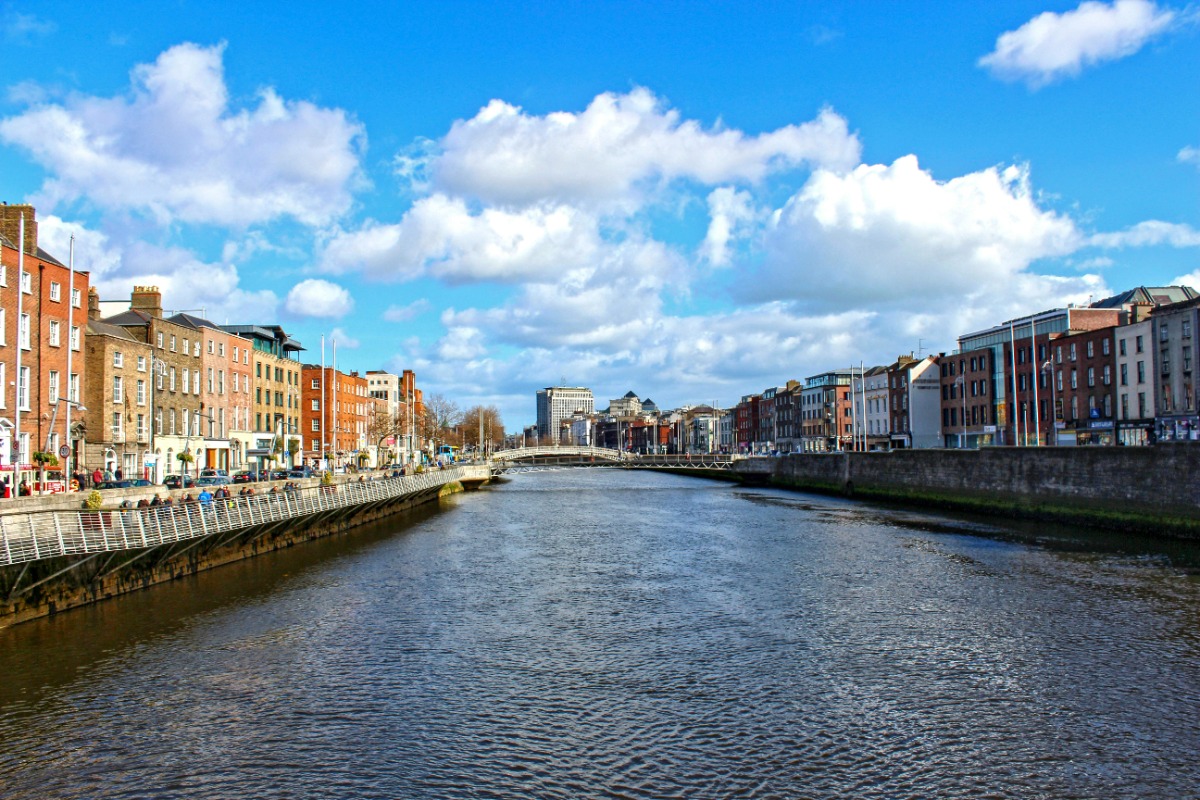
Dublin · 2h 20m
Hidden Dublin: Main Attractions and Hidden Stories
Embark on a captivating stroll through Dublin City with our guided tour. Uncover hidden stories of the Republic of Ireland's capital as we visit iconic sites often overlooked. Explore the past and beauty of the Fair City like never before!
- places
- Dublin
- Molly Malone
- Irish folklore
- Dublin history
- self-guided tours