
Gdańsk, Poland2 min read
Neptune's Fountain Gdańsk: The Sea God Facing Artus Court
Neptune's Fountain on Google Maps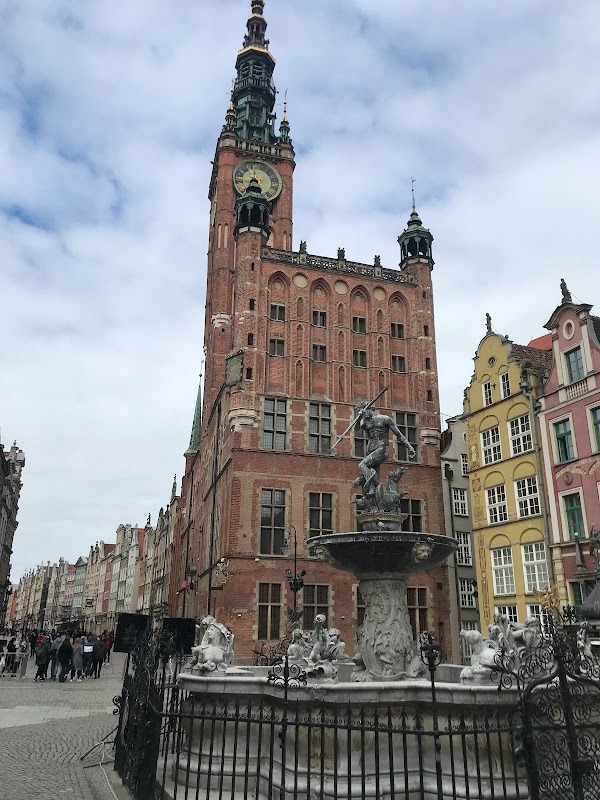
Neptune's Fountain Gdańsk is a historic fountain on the Długi Targ, directly in front of the entrance to Artus Court. It is a Mannerist-Rococo masterpiece and one of the city's distinctive landmarks, but its most revealing detail is the relationship between its sea-god figure and the merchant court behind it. Constructed in the early 17th century, the fountain once operated only on specific days because the available water pressure could not maintain it continuously.
What is Neptune's Fountain in Gdańsk?
Neptune's Fountain is the monumental fountain standing before Artus Court on Gdańsk's Długi Targ. Its artistic character is described as Mannerist-Rococo, and its central sculpture represents Neptune, the sea god. Kashubians use the nickname Krësztof for the sculpture.
The fountain was constructed in the early 17th century and became one of Gdańsk's most distinctive landmarks. Its setting is part of its meaning: this is not simply a sculpture placed in a square, but a sea-linked monument positioned directly at the entrance to a building associated with merchants.
Why does Neptune's Fountain stand in front of Artus Court?
The city council commissioned the fountain, and its position was chosen to connect Gdańsk's maritime wealth with the merchants associated with Artus Court. The bronze figure was cast in 1615 by Peter Husen and Johann Rogge, based on a design by Abraham van den Blocke; the fountain itself was installed in 1633.
From the fountain, the sea god faces the building that represented the merchants who controlled the source of the city's wealth: the sea. That visual connection turns the space between Neptune and Artus Court into a statement about Gdańsk's prosperity and maritime power.
The surrounding iron railing adds a political dimension. It features the Polish Eagle and Gdańsk's coat of arms, expressing the city's status as a semi-autonomous port under the Polish crown. The sculpture, its placement and the railing therefore bring maritime power, merchant control and civic status into one compact landmark.
What should you notice about Neptune's Fountain?
Look beyond the bronze figure to the fountain's water system: it was a significant hydraulic engineering project for its time. A dedicated system drew water from the Siedlce reservoir through a network of wooden pipes, and in 1634 the fountain gained a filtration and delivery system.
The system also explains why the fountain's operation was unusual. During the 17th century, insufficient water pressure from the Potok Siedlecki meant that it could operate only on specific days. Specialized operators managed the water flow, turning the fountain's operation into a scheduled public event rather than a continuously running feature.
That history gives the monument a precise civic role. Neptune's Fountain transformed a utilitarian water source into civic branding, emphasizing that Gdańsk's prosperity was tied to maritime power. The Merchant Republic - Gdańsk's Golden Age (1550-1650) examines that connection, with Neptune's Fountain appearing as stop 4 of 8.
To explore Neptune's Fountain in its wider merchant-and-maritime context, visit the Merchant Republic - Gdańsk's Golden Age tour.
The tour that visits Neptune's Fountain
Each one is a self-guided route you can start whenever you like.

Gdańsk · 1h 20m
The Merchant Republic — Gdańsk’s Golden Age (1550–1650)
Discover Gdańsk's Golden Age on this immersive walking tour through the Main Town. Explore stunning Flemish Mannerist architecture, legendary merchant halls, and iconic landmarks like the Golden Gate, Artus Court, Neptune's Fountain, and the mighty Crane. Step into the world of 16th–17th century trade, culture, and opulence.
- places
- Gdańsk
- Neptune's Fountain
- Artus Court
- Gdańsk history
- landmarks