
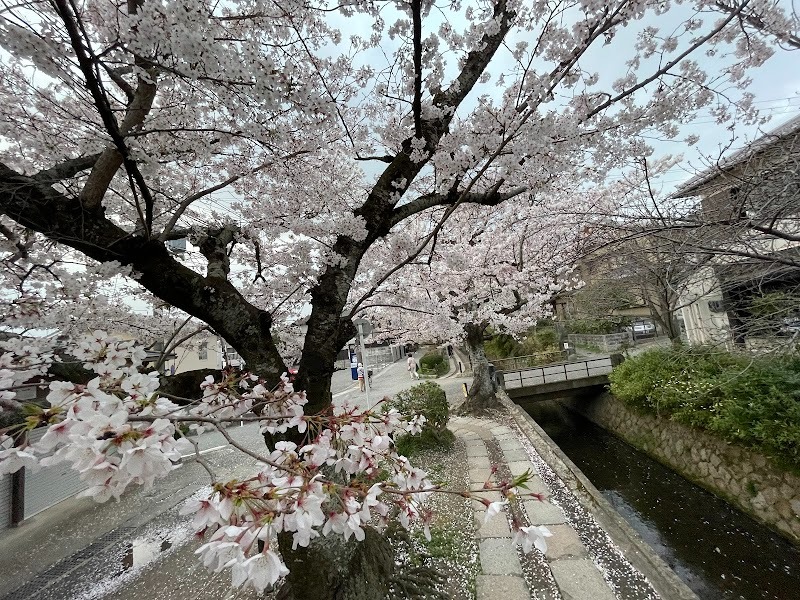
Three poetic symbols wait along Philosopher's Path: the kanji for “dream,” an image of a crane and a haiku etched by an anonymous hand. Finding them gives you a reason to look beyond the cherry trees as you walk this distinctive Kyoto route.
What is Philosopher's Path in Kyoto?
Philosopher's Path is a pedestrian path in Kyoto, Japan, running between Ginkaku-ji and Nanzen-ji. It follows a cherry-tree-lined canal and a shallow irrigation channel supplied by the Lake Biwa Canal, giving the walkway a clear physical character: water beside the path, trees overhead and temples at either end.
The canal is not just scenery. Its steady presence shapes the route, while the trees change the view through the year. The path is lined with cherry trees, and camellias and maples also appear along the walkway.
When did Philosopher's Path open?
The path first opened in 1890 and was extended again in 1912. Its course follows the shallow irrigation channel that brings water from the Lake Biwa Canal, so the walk you take today is tied to the canal's older engineering history rather than being a path laid independently of it.
Why is it called Philosopher's Path?
The name comes from philosopher Nishida Kitaro, who made the walk his daily promenade during the Taisho era, from 1912 to 1926. You may also see the alternate name “Philosopher's Walk”; it refers to the same Kyoto path.
That connection turns an ordinary detail of the route—the act of walking beside the canal—into the place's defining association. The path became linked with a philosopher who used it regularly, not with a separate monument or attraction.
What can you look for along Philosopher's Path?
Look first for the three poetic symbols hidden along its length: the kanji for “dream,” a crane and a haiku carved by an anonymous hand. They are described as waiting to be discovered, so the path rewards attention to its smaller details as well as its trees and water.
The surroundings include the soft gurgle of the canal and the distant sound of students from Kyoto University. Camellias and maples add to the cherry-tree-lined setting. A local rumour also mentions a tuxedoed cat said to be the reincarnation of a famous poet; treat that as a story associated with the path, not a verified fact.
How can you explore Philosopher's Path?
Walk with three things in mind: the canal beside you, the changing trees and the three poetic symbols. If you want an interactive way to notice the details, Kyoto's Kingly Keepsakes visits this place at stop 3 of 8 and leaves its own challenge open for you to solve.
Use the path as one part of a longer exploration rather than assuming it is the route's final stop. To follow the wider experience, start with the Kyoto keepsakes route, then let the canal, trees and hidden marks guide your attention here.
The tour that visits Philosopher's Path
Each one is a self-guided route you can start whenever you like.

Kyōto · 2h 15m
Kyoto's Kingly Keepsakes
Embark on a solo, immersive walking tour through Kyoto's eastern treasures. Begin at the iconic Ginkakuji Temple, sip artisan coffee at local cafés, stroll the cherry-blossom-lined Philosopher's Path, and explore hidden temples and shrines. Conclude with panoramic city views from Shogunzuka Mound. This one-day journey blends centuries of history, culture, and nature—perfect for solo travelers seeking a dramatic, contemplative adventure.
- places
- Kyōto
- Kyoto
- Philosopher's Path
- Japan
- walking routes
- cultural places