
Verona, Italy3 min read
Piazza delle Erbe Verona: History and Landmarks
Piazza delle Erbe on Google Maps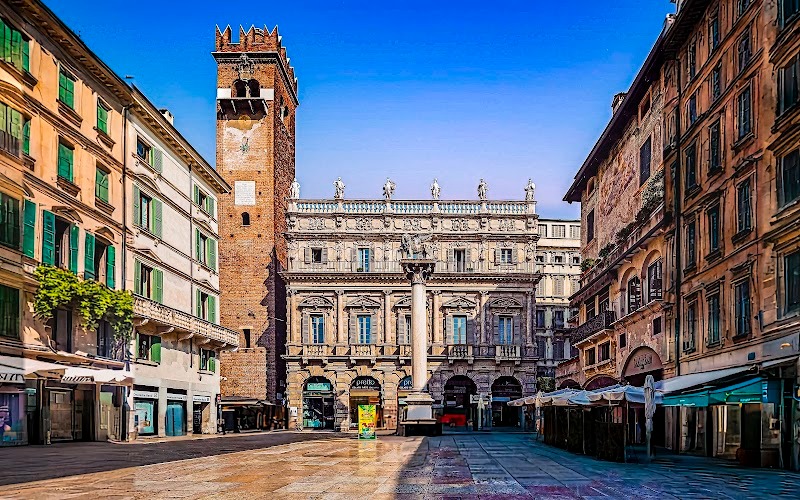
Piazza delle Erbe is a historic square in Verona, northern Italy, occupying the site of the city's ancient Roman Forum. From the 1st century BC onward, this was Verona's political and commercial centre; through the medieval and Renaissance periods, it remained the city's principal marketplace and gathering space.
The square's importance comes from that continuity. Piazza delle Erbe was not only a place for trade: its towers, merchant houses and civic buildings also reflected the power struggles of Verona's noble families. The architecture around the square therefore records both everyday commerce and the public competition for influence within the city.
What is Piazza delle Erbe Verona?
Piazza delle Erbe is Verona's long-standing civic and commercial heart, built over the urban space that served as the Roman Forum during the Roman Empire. Its role changed in appearance across the centuries, but the square continued to bring together marketplace activity, public gatherings and the visible presence of civic and noble power.
That layered role explains why the square matters beyond its individual buildings. In one urban space, Verona's Roman political centre became a medieval and Renaissance marketplace, while the surrounding architecture showed which families and institutions could shape public life.
What can you see in Piazza delle Erbe?
The Madonna Verona fountain is one of the square's clearest historical markers. It was constructed in 1368 around a Roman statue dating to approximately 380 AD, bringing together a medieval civic work and a much older Roman object in the centre of Piazza delle Erbe.
The Mazzanti Houses retain their 16th-century frescoes, adding a distinctive painted surface to the merchant buildings around the square. Their decoration belongs to the later history of a place that had already served as Verona's principal marketplace for centuries.
The Torre dei Lamberti is another of Piazza delle Erbe's important historic landmarks. Its bell regulated civic life and public events, giving the tower a practical role in the organisation of the square as well as a commanding place among its buildings. Together, the fountain, frescoed houses, tower, merchant buildings and civic architecture show how commercial life and public power occupied the same space.
Why is Piazza delle Erbe important to Verona's Romeo and Juliet history?
Piazza delle Erbe helps explain the public atmosphere behind Verona's Romeo and Juliet tradition. The rival Capulets and Montagues were adapted from the historical Cappelletti and Montecchi factions, mentioned by Italian writers before Shakespeare, including Dante Alighieri in the Divine Comedy.
Those factions represented violent political conflicts associated with Guelph and Ghibelline alliances in northern Italian cities. As Verona's main civic square, Piazza delle Erbe would have been a natural setting for public disputes, displays of family power, commercial encounters and social gatherings—the kind of public visibility that surrounds the opening street conflict between the rival households in the Romeo and Juliet tradition.
Early Italian writers who shaped the legend also described Verona as a densely populated city marked by noble rivalries, family honour and constant public visibility. Luigi da Porto and Matteo Bandello presented a city where private relationships could quickly become matters of public scandal. The Romeo and Juliet Verona Tour visits Piazza delle Erbe to connect the square's physical setting with this literary and political history.
What should you notice when you stand in Piazza delle Erbe?
Read Piazza delle Erbe as a layered civic space: first a Roman forum, then a medieval and Renaissance marketplace, and throughout its history a setting for public gatherings. The fountain, frescoed houses, Torre dei Lamberti, merchant buildings and civic architecture are not separate details; together they show how trade, public administration and noble influence shared the square.
For a place-specific interpretation of those connections, use the Piazza delle Erbe stop on the Romeo and Juliet Verona Tour. It places the square's landmarks within Verona's political and literary history without reducing Piazza delle Erbe to a backdrop: the square itself is the evidence.
The tour that visits Piazza delle Erbe
Each one is a self-guided route you can start whenever you like.
Verona · 1h 15m
Romeo and Juliet Verona Tour
Walk in the footsteps of Romeo and Juliet on this immersive self-guided tour of Verona. Discover medieval houses, legendary balconies, and ancient tombs as you unravel the real history and enduring myths behind the world's most famous love story. Perfect for romantics, literature lovers, and curious explorers alike!
- places
- Verona
- Piazza delle Erbe
- Romeo and Juliet
- Italian history
- city landmarks