
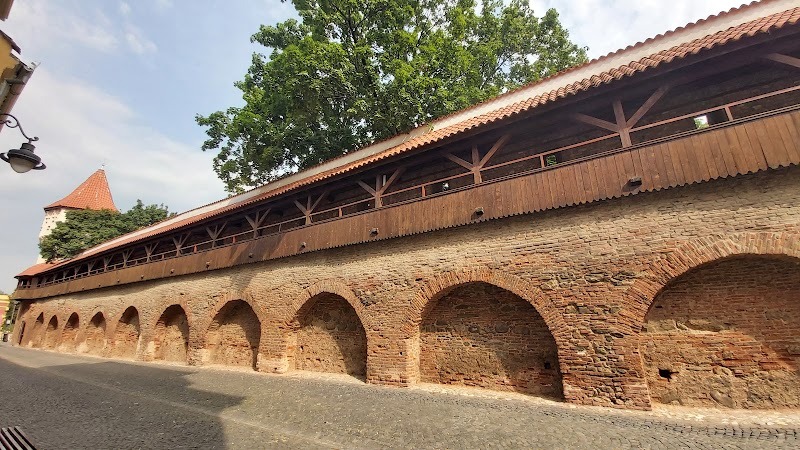
What is Strada Cetății in Sibiu?
Strada Cetății is a street following one of the best-preserved sections of Sibiu's medieval defensive system. Its fortifications were originally built between the 14th and 15th centuries, when the Saxon city of Hermannstadt became one of the strongest fortified towns in Transylvania.
The street matters because its defensive remains belong to the system that protected Sibiu as the city developed into an important fortified settlement. The walls along Strada Cetății are not an isolated monument: they are part of the military architecture that shaped the edge of the historic Upper Town.
How did Strada Cetății fit into Sibiu's medieval defenses?
Strada Cetății formed part of a fortress that, at its height, had three defensive rings of walls, more than 30 towers and several fortified gates. These defenses protected an important trade center on routes between Central Europe and the Balkans, giving the walls a practical role beyond marking the town's boundary.
The towers along the street included the Carpenters' Tower and the Arquebusiers' Tower. Powerful craft guilds maintained and defended specific sections of Sibiu's walls, so these towers also show how responsibility for the city's security was distributed among its organized trades.
Strada Cetății should be understood as one section of that wider fortress rather than a complete inventory of its surviving walls, towers and gates. Its significance comes from the concentration of defensive features along the street and from the way they represent Sibiu's larger medieval system.
What can you notice along Strada Cetății?
Look closely at the defensive walls and their narrow loopholes, also called embrasures. These openings were cut into the masonry so defenders could fire muskets or arquebuses while remaining protected behind the walls' thick masonry.
The street also preserves the military meaning of the wall corridor. After the Habsburg Empire took control of Transylvania after 1691, the fortifications were still maintained and patrolled. Sibiu became the administrative and military center of the province, and imperial soldiers were stationed in the city's garrison.
Guards walked the corridor along the northern edge of the Upper Town, watching the approaches to the fortress and controlling movement near the defensive perimeter. As you examine Strada Cetății, the thick masonry and small firing openings are the clearest physical details connecting the street to that work of surveillance and defense.
How can you explore Strada Cetății in Sibiu?
Explore Strada Cetății by examining the defensive walls, the towers associated with the street and the loopholes cut into the masonry. The Hermannstadt: Sibiu Under the Habsburgs (1690-1780) route includes Strada Cetății as stop 4 of 8, adding historical context to the features you can study there without turning the street into a passive backdrop.
The tour that visits Strada Cetății
Each one is a self-guided route you can start whenever you like.

Sibiu · 1h 25m
Hermannstadt: Sibiu Under the Habsburgs (1690–1780)
March through Sibiu's storied past as the Habsburg Empire's garrison capital! Explore grand squares, medieval towers, and mighty bastions, uncovering the military life, patrol routes, and imperial intrigue that shaped Transylvania's fortress city between 1690 and 1780.
- places
- Sibiu
- Strada Cetății
- Hermannstadt
- medieval fortifications
- Transylvania