
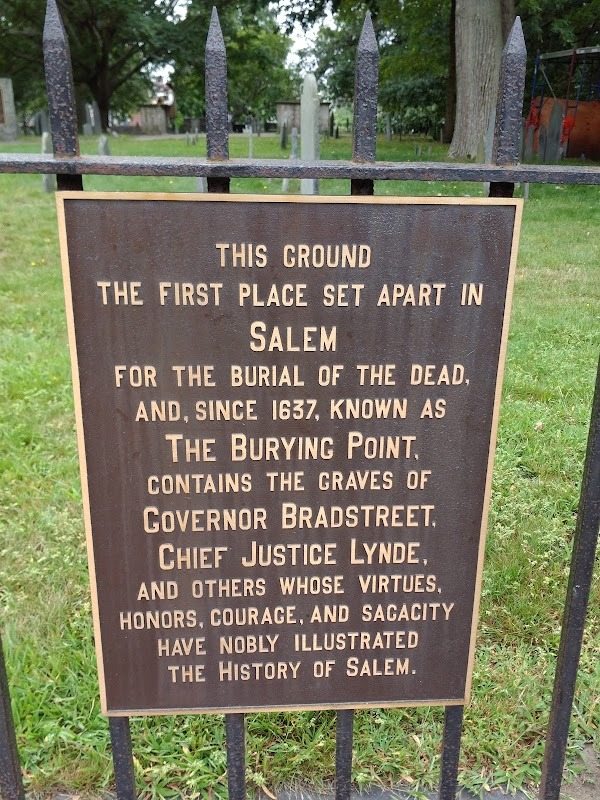
The Burying Point in Salem, Massachusetts, is Charter Street Cemetery, also called the Old Burying Point. It is Salem's oldest burial ground, located in a historic coastal city in Essex County on the North Shore of Greater Boston.
What is The Burying Point in Salem, MA?
The Burying Point is the historic name for Charter Street Cemetery. “Old Burying Point” is another name for the same cemetery, reflecting its status as Salem's oldest burial ground. The site belongs to Salem's early civic landscape, in a city that became one of the most significant seaports for trading commodities in early American history.
What can the graves at The Burying Point tell you about Salem?
The graves at The Burying Point show which people in colonial Salem were given marked, public places of memory. Members of Salem's colonial elite are buried there, including Judge John Hathorne, one of the magistrates most closely associated with the witch-trial examinations.
The cemetery's stones preserve a visible record of Salem's social order. Prominent families, civic leaders, and religiously respectable citizens received marked places of memory at The Burying Point. The cemetery therefore documents more than individual burials: it shows how status and public respect were represented in colonial Salem.
How is The Burying Point connected to the 1692 witch trials?
The Burying Point's connection to the 1692 witch trials is defined by a sharp contrast between those remembered there and those who were executed. The executed victims were not honored with public graves at the cemetery. Their bodies were associated with shame, and family members may have recovered some remains privately, but the victims were denied the official remembrance given to Salem's powerful.
Judge John Hathorne's presence at The Burying Point also keeps the trial-era legacy tied to the cemetery. That legacy continued into American literature through his descendant Nathaniel Hawthorne, author of The Scarlet Letter. Nathaniel Hawthorne altered the family name by adding a “w,” a change often linked to discomfort with the family's reputation from the trial era.
What should you notice when you visit The Burying Point?
Read The Burying Point as a record of who received marked public memory in colonial Salem. The marked graves of colonial elites, civic leaders, prominent families, and religiously respectable citizens stand in contrast to the absence of public graves for the executed victims of 1692.
For place-based historical context, Witches of Salem: Historical Trials & Memory Walk visits The Burying Point as stop 3 of 8. Its treatment of the cemetery focuses attention on the stones, the people commemorated there, and the unequal legacy of Salem's witch trials.
The tour that visits The Burying Point
Each one is a self-guided route you can start whenever you like.
Salem, MA · 1h 45m
Witches of Salem: Historical Trials & Memory Walk
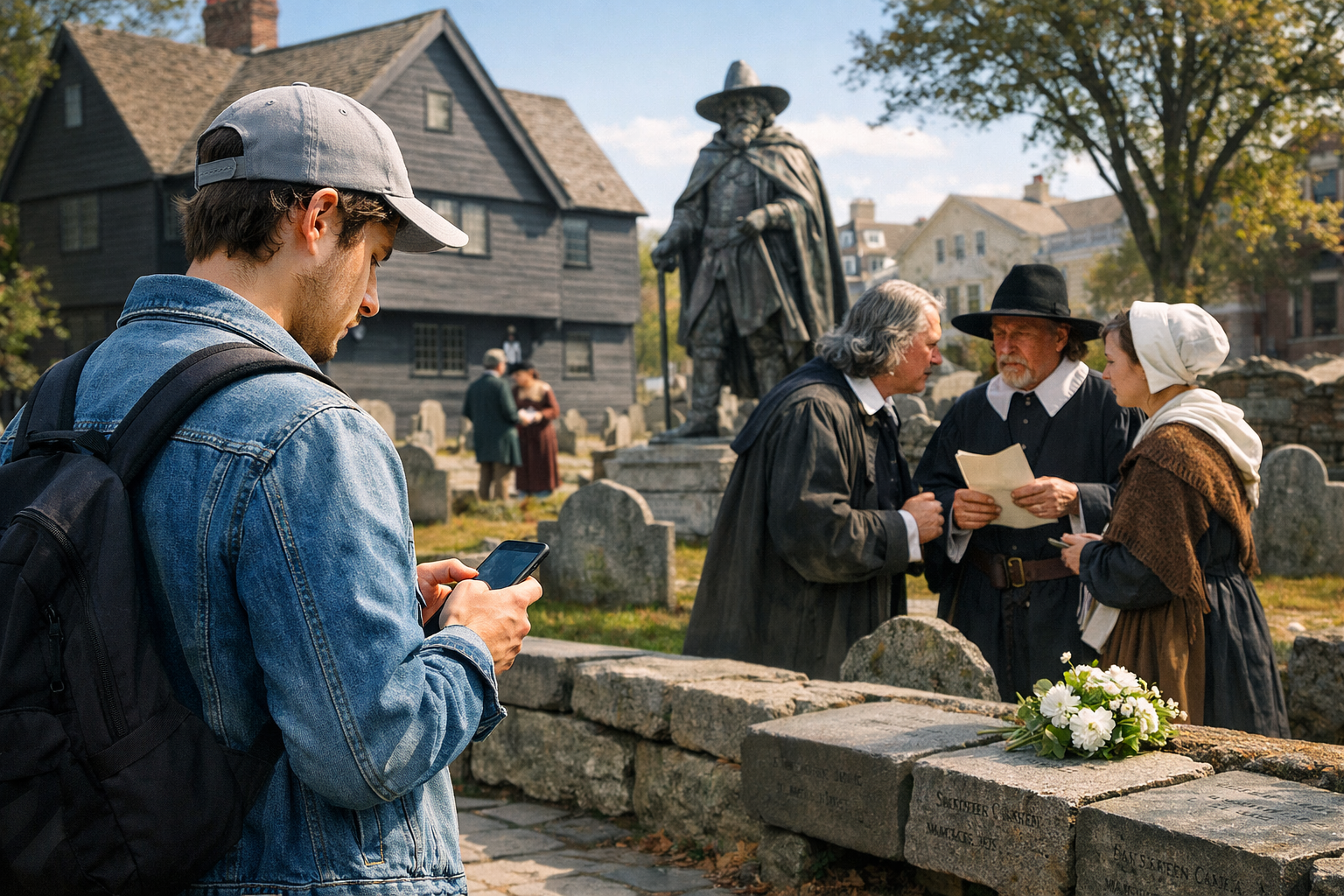
A walkable historical Salem tour that connects the 1692 witch trials into one clear story: Puritan beginnings, social tension, accusations, spectral evidence, legal failure, punishment, remembrance, and modern tourism. Includes the Witch House, Old Town House Site, Charter Street Cemetery, Witch Trials Memorial, Bewitched statue, and Proctor’s Ledge.
- places
- Salem, MA
- Salem
- The Burying Point
- Charter Street Cemetery
- Salem witch trials
- Massachusetts history