
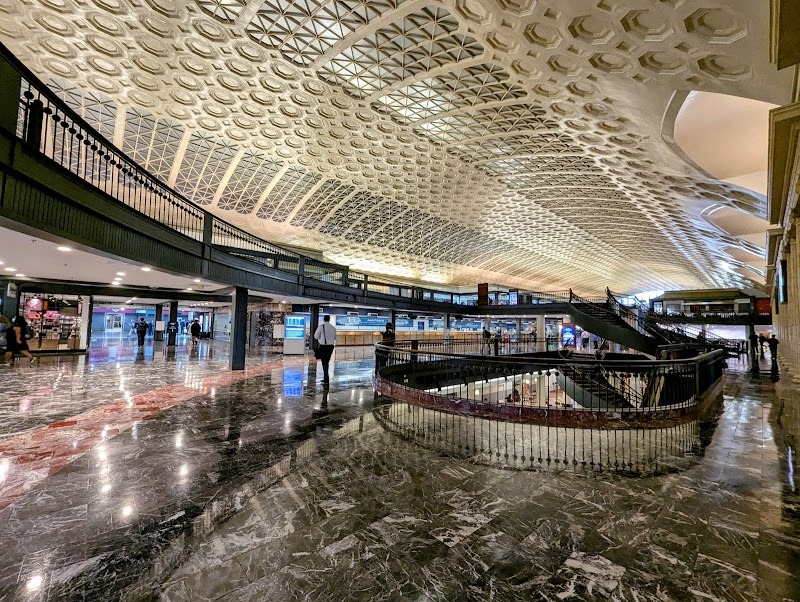
Union Station Washington, D.C., known locally as Union Station, is a major train station, transportation hub, and leisure destination in the capital. Opened in 1907 and designed by Daniel Burnham in the Beaux-Arts style, it is also a gateway into the history of federal power, national rail travel, and Washington's growth.
What is Union Station Washington, D.C.?
Washington Union Station is the southern terminus of the Northeast Corridor, the electrified rail line running north through Baltimore, Philadelphia, New York City, and Boston. That position connects the capital to the busiest passenger rail line in the nation and makes the station part of a network that links major cities along the eastern United States.
Its importance is not only logistical. Union Station combines a major rail terminal with a civic and leisure destination, giving transportation infrastructure a prominent place in the capital's public identity. The Washington DC: Power & Institutions Tour includes Union Station as its first stop, placing the building within a wider story about Washington's institutions and national ambitions.
Why was Union Station built?
Union Station opened as part of the McMillan Plan, a major urban redesign effort intended to transform Washington into a monumental federal capital comparable to the great European capitals of the era. Its construction made the station part of a planned reshaping of the city, rather than an isolated response to passenger demand.
The practical problem was the rapid expansion of the national railroad network. At a time when rail travel dominated long-distance transportation in the United States, Washington needed a direct connection to that growing system. Union Station unified multiple competing rail lines into a single transportation hub, giving the capital one major terminal instead of leaving its rail connections divided.
That location and scale also made transportation infrastructure part of Washington's civic and governmental ambitions. The station connected the national capital to the wider country while presenting arrival in monumental architectural terms.
What should you notice about Union Station's architecture?
Union Station's massive vaulted ceilings, marble halls, classical columns, and monumental sculpture are the details that define its architectural message. Designed by Daniel Burnham in the Beaux-Arts style, the building uses scale and classical form to project order, permanence, and national unity.
Those features were not simply generic grandeur. They reflected the ambitions of the federal government during the Progressive Era, when Washington was being shaped as a monumental national capital. The station's architecture expresses the idea that the country's rail network, government, and civic identity could be gathered into one ordered gateway.
How did Union Station shape Washington's history?
Union Station became a ceremonial gateway into the capital, welcoming presidents, diplomats, soldiers, immigrants, and visitors arriving from across the country. During the first half of the 20th century, it was one of the busiest terminals in the country, giving the station a direct role in the movement of people into national political life.
During both World Wars, millions of military personnel passed through Union Station as Washington expanded into a wartime administrative center. Rail connections also supported the movement of lawmakers, bureaucrats, military officials, and commercial goods between the capital and the rest of the nation.
Union Station therefore reveals how transportation infrastructure became tied to federal expansion and industrial growth. Its rail links formed part of the logistical backbone needed to govern an increasingly large and interconnected industrial republic. To encounter that history in context, follow the Washington DC: Power & Institutions Tour.
The tour that visits Union Station
Each one is a self-guided route you can start whenever you like.

Washington, D.C. · 2h 15m
Washington DC: Power & Institutions Tour
Explore the iconic heart of Washington DC on this immersive self-guided tour. Walk through the power corridors of Congress, the White House, the Supreme Court, and more. Uncover the secrets, history, and drama behind America's most influential institutions—perfect for history buffs, curious travelers, and anyone fascinated by the machinery of democracy.
- places
- Washington, D.C.
- Union Station
- architecture
- American history
- rail travel