
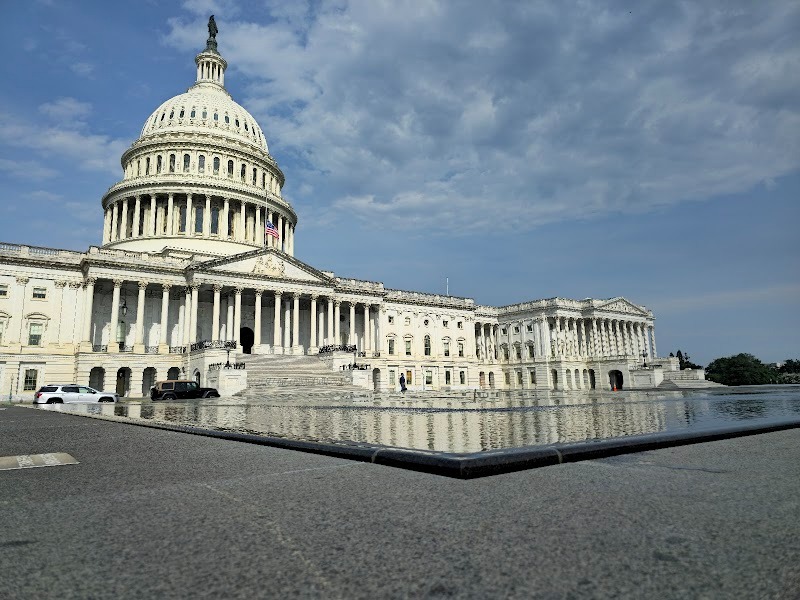
The United States Capitol, also called the Capitol or Capitol Building, is the seat of the United States Congress and the legislative branch of the federal government. It stands on Capitol Hill at the eastern end of the National Mall in Washington, D.C., with a white neoclassical exterior that has made it one of the capital's defining buildings.
The Capitol is also a reference point for the city itself: it forms the origin of Washington, D.C.'s street-numbering system and its four quadrants, even though it is no longer at the geographic center of the capital.
What is the United States Capitol?
The United States Capitol is the building where the country's legislative branch is based. Its location gives it a precise role in Washington's planned geography: the building sits atop Capitol Hill at the eastern end of the National Mall, anchoring one of the most important axes of the federal city.
Its architecture is neoclassical, and its exterior is white. Those characteristics distinguish the Capitol from an ordinary government office and give the building a formal visual language associated with public authority. Its position and design work together: the Capitol is both a functioning seat of Congress and a deliberately prominent symbol within Washington's urban plan.
How did the Capitol become a symbol of American government?
The Capitol became the physical and symbolic center of American representative government after Congress relocated from Philadelphia to Washington in 1800. It was positioned atop Capitol Hill at the center of Pierre Charles L'Enfant's original urban plan for the federal city, giving the legislative branch a defined place in the capital's design.
The building's development followed the political and territorial growth of the United States. During the 19th century, the original structure was repeatedly enlarged to accommodate additional senators and representatives as new states entered the Union. The changes made the Capitol a physical record of an expanding representative system.
Its cast-iron dome, completed during the Civil War, became a symbol of national unity while the country faced potential collapse. The dome was topped by the Statue of Freedom in 1863, projecting the resilience and continuity of the federal government during wartime. The Capitol's symbolism therefore comes not only from its role as Congress's home, but also from the way its most recognisable architectural feature was completed during a national crisis.
The building has also been the setting for presidential inaugurations, congressional debates, protests, funerals, wartime legislation, impeachment proceedings, and civil rights demonstrations. These events connect the Capitol's architecture to the contested, public work of representative government.
What can you notice about the Capitol's interior and setting?
The Rotunda contains monumental paintings and sculptures that present an official narrative of American history. Its interior is therefore not simply decorative: the artwork expresses how the nation has chosen to represent its own past inside the building of Congress.
The crypt and corridors beneath the Capitol reveal another side of the institution. They reflect the logistical and political complexity required to operate the federal legislature, contrasting with the ceremonial scale of the Rotunda and dome above.
The Capitol's setting reinforces its meaning. Its position on Capitol Hill and at the eastern end of the National Mall connects the building to Washington's planned federal city, while its role as the origin point for the district's street-numbering system gives it a practical relationship with the capital beyond its political function.
To place the United States Capitol within Washington's wider political landscape, follow the Washington DC: Power & Institutions Tour. The route treats the Capitol as one part of the city's network of federal institutions, while the building itself remains the central subject: Congress, its architecture, and the national history represented around it.
The tour that visits United States Capitol
Each one is a self-guided route you can start whenever you like.

Washington, D.C. · 2h 15m
Washington DC: Power & Institutions Tour
Explore the iconic heart of Washington DC on this immersive self-guided tour. Walk through the power corridors of Congress, the White House, the Supreme Court, and more. Uncover the secrets, history, and drama behind America's most influential institutions—perfect for history buffs, curious travelers, and anyone fascinated by the machinery of democracy.
- places
- Washington, D.C.
- United States Capitol
- Washington DC
- American government
- neoclassical architecture
- Washington landmarks