
Jun 2, 20268 min readLeplace
Best App for City Exploration? What to Look For
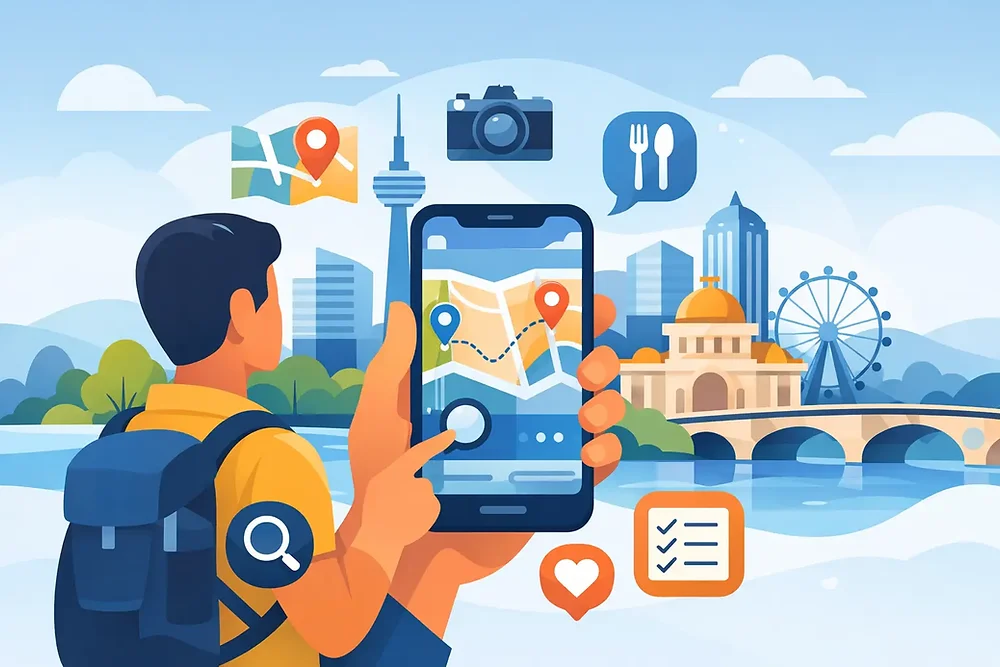
You land in a new city, open your phone, and instantly face the usual split. One app shows pins. Another sells tickets. Another plays audio while you stare at a screen and try not to miss the turn. If you are searching for the best app for city exploration, the real question is not which app has the most listings. It is which one turns the city itself into the experience.
That difference matters more than most travel guides admit. A city is not a checklist of monuments. It is movement, timing, atmosphere, hidden details, and stories that only make sense when you encounter them in the right place. The best apps do more than help you get from A to B. They create a reason to keep going.
What makes the best app for city exploration?
A strong city exploration app should feel like a live layer over the streets around you. It should guide, surprise, and reward you without turning the experience into a chore. That means maps alone are not enough, and traditional self-guided audio tours often are not enough either.
The best app for city exploration usually combines four things: location awareness, interactive storytelling, flexible pacing, and a clear sense of progression. When those elements work together, the city stops feeling passive. It becomes playable, memorable, and personal.
Location awareness is the baseline. If an app cannot understand where you are and respond to that in real time, it is just digital brochureware. Good exploration apps use GPS in a way that feels natural. You move, the story moves. You reach a landmark, a challenge appears. You step into the right square, alley, or waterfront path, and the app gives that place context.
Interactive storytelling is where the experience starts to separate itself from old-school tourism. Instead of pressing play on a long monologue, you get prompts, missions, clues, or decisions that pull you into the city. That can mean solving riddles, following a trail, collecting virtual items, uncovering local legends, or moving through a neighborhood with a clear objective. You are not just consuming information. You are participating in it.
Flexible pacing matters because travelers are not all moving the same way. Some want a two-hour challenge with friends. Others want to drift through a district with coffee stops, photo breaks, and zero pressure. A great city app respects both. It should let you start when you want, pause when you want, and continue without feeling like you have broken the experience.
Progression is the feature people often overlook, but it changes everything. Humans like momentum. We like knowing we are getting somewhere. The best exploration apps build that feeling through checkpoints, completed missions, unlocked content, or narrative beats. It is the difference between wandering and being on an actual journey.
Why standard travel apps often fall short
A lot of popular travel apps are useful, but usefulness is not the same as exploration. Mapping apps are excellent for navigation. Booking apps are excellent for logistics. Review platforms are excellent for social proof. None of those, on their own, create immersion.
That is why many city experiences still feel fragmented. You book in one place, navigate in another, read background in a third, and then try to stitch it together yourself while standing on a noisy street corner. For travelers who want autonomy, that setup works just well enough to be frustrating.
The trade-off is simple. General apps give breadth. Specialized exploration apps give depth. If your goal is to compare restaurant ratings or find the nearest subway station, breadth wins. If your goal is to feel connected to a city, depth usually matters more.
Traditional audio guides have a similar limitation. They can be informative, but they are often passive and linear. You follow a route, listen to commentary, and move on. That works for some visitors, especially those who prefer a museum-style format. But for travelers who want energy, surprise, and agency, passive listening can feel flat.
The features that actually change the experience
If you are comparing options, there are a few features that move an app from helpful to unforgettable.
First, look for real interactivity. Not just tap-to-read descriptions, but actions that connect the digital experience to the physical environment. Challenges, geofenced tasks, scavenger hunt mechanics, puzzle solving, and live mission prompts all create a stronger sense of place because they require attention. You are not skimming a city. You are engaging with it.
Second, pay attention to local storytelling. A polished interface means very little if the content is generic. The best city exploration experiences feel rooted in the destination. They surface hidden histories, neighborhood identities, street-level culture, and stories that would never make the top ten attractions list. This is where creator-led and locally designed tours often outperform mass-market content. They know the texture of the place.
Third, check whether the app supports self-guided freedom without losing structure. That balance is harder than it sounds. Too much freedom and the experience feels vague. Too much structure and it feels restrictive. The strongest platforms create a guided path that still leaves room for spontaneity. You know where to go next, but you also feel like the city belongs to you.
Fourth, consider whether the experience is social. Not every traveler wants to compete, but many want to share the moment. Apps that work well for couples, friend groups, team outings, and solo travelers tend to have stronger replay value. Competition, collaboration, and shared discovery all make a city more vivid.
Best app for city exploration for different travel styles
There is no single perfect app for every kind of traveler, because city exploration means different things depending on your pace and purpose.
If you are a solo traveler, the best app for city exploration is often one that creates structure without forcing group dynamics. You want confidence, independence, and enough narrative momentum to make the route feel intentional. Interactive self-guided tours work especially well here because they reduce decision fatigue while still leaving room for personal detours.
If you are traveling as a couple, experience design matters more. A route with game elements, story beats, or discovery challenges creates shared memories faster than a standard walking map ever will. The city becomes something you do together, not just something you look at.
If you are with friends, group energy matters. Competitive or mission-based formats usually land better than passive audio. People want moments to react, compare, laugh, and move. That makes exploration games, outdoor challenge routes, and treasure-hunt style experiences particularly strong.
If you are planning for a tourism brand, guide business, museum, event organizer, or destination team, the best app is not just the one travelers enjoy. It is the one that can package your local stories into mobile products people will actually buy and complete. That means creator tools, monetization options, route control, branded experiences, and scalable delivery are part of the decision.
Why interactive city apps are gaining ground
Traveler behavior has changed. People still want landmarks, but they also want agency. They want content that reacts to their location, feels mobile-first, and gives them more than facts. They want story, movement, challenge, and proof that they discovered something for themselves.
That shift is why interactive platforms are gaining so much traction. They fit how people already use their phones while traveling. Not as passive screens, but as live companions for navigation, photos, planning, and communication. When an app combines those habits with exploration mechanics, it feels current in a way static tours do not.
There is also a business reason this format keeps growing. Cities, creators, and tourism operators need experiences that are easier to distribute, easier to update, and easier to monetize than traditional guided products. A mobile platform with self-guided delivery and game-style engagement solves multiple problems at once.
This is exactly where a platform like Leplace stands out. It treats city discovery as an interactive, self-guided mobile experience rather than a digital copy of an old tour format. That means walking routes can become story-driven games, local creators can publish their own city experiences, and travelers can move through a destination with more curiosity and momentum.
How to choose without overthinking it
Start with your goal. If you only need directions and opening hours, a broad travel stack is fine. If you want the city itself to feel alive, choose an app built around exploration, not just information.
Then look at the content style. Does it feel generic, or does it sound like somebody actually knows and loves the place? Is the route something you could remember afterward, or just another sequence of stops? That answer tells you a lot.
Finally, ask whether the app gives you a reason to keep your head up. The best city experiences do not trap you in endless scrolling. They push you back into the street, toward the details, the atmosphere, and the next discovery.
A great city app should make you feel like you found something, not just followed something. That is the standard worth using.
Enjoyed this post?
Comments
Be the first to comment.