
May 26, 20267 min readLeplace
What Is a Self Guided Tour, Really?
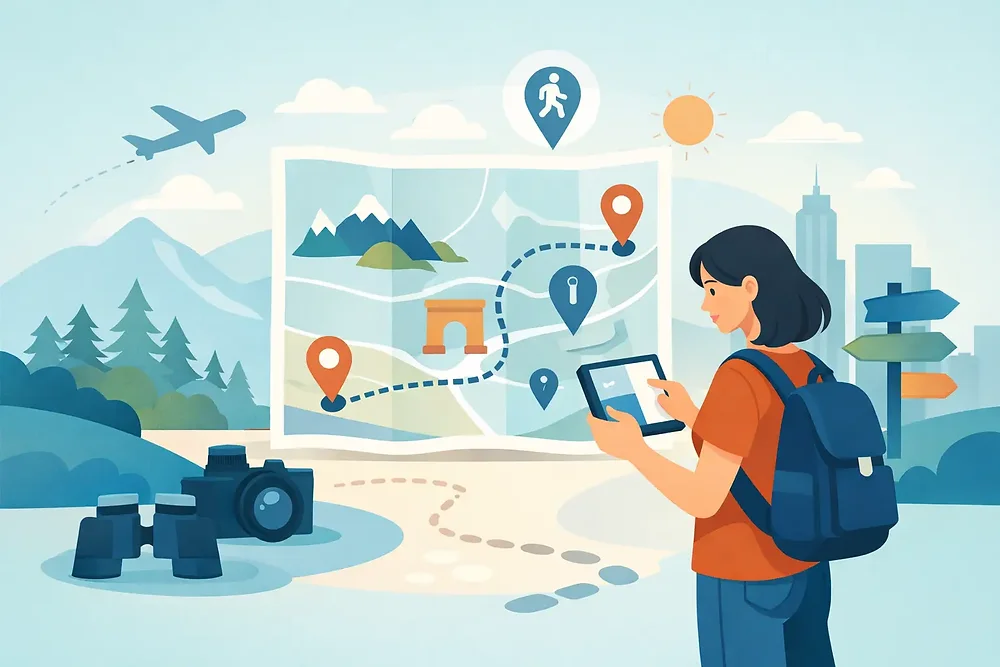
Miss the start time for a group tour, and the whole plan can fall apart. A self-guided tour solves that problem fast - but the best version of it does much more than replace a human guide with a map. It turns a city into something you can explore on your own terms, at your own pace, with your phone acting less like a screen and more like a key.
So, what is a self guided tour? At its simplest, it’s a tour you take without a live guide physically leading the group from stop to stop. You follow a route, a set of prompts, or a mobile experience that helps you discover a place independently. That might mean audio narration, text-based storytelling, GPS-triggered content, challenges, hidden locations, or interactive tasks that react to where you are in the real world.
The old version of a self-guided tour was straightforward. You got a printed map, maybe a brochure, and walked around reading signs. The newer version is far more dynamic. In many cities, self-guided experiences now blend storytelling, navigation, local history, and game mechanics into one mobile journey. Instead of passively consuming facts, you actively move, search, solve, and discover.
What is a self guided tour today?
Today’s self-guided tour is less about replacing a tour guide and more about redesigning the experience. For travelers, that means freedom without losing structure. For creators and tourism organizations, it means delivering high-quality city exploration without needing a guide present for every booking.
A modern self-guided tour usually lives on a smartphone. It can guide you through neighborhoods, landmarks, museums, historic districts, public art routes, food scenes, or themed adventures. Some are purely informational. Others are built like real-life exploration games, with clues, missions, checkpoints, and rewards that make the city feel interactive.
That difference matters. A static tour tells you where to look. An interactive one gives you a reason to keep going.
How a self-guided tour actually works
Most self-guided tours follow a simple structure, even when the experience feels advanced. You start by choosing a route or theme. Then the tour delivers content as you move through physical locations. Depending on the format, your phone may show written instructions, play audio, trigger location-based scenes, or ask you to complete tasks before unlocking the next part.
In practice, the experience can look very different from one platform to another. Some tours feel like a walking podcast. Some feel like a treasure hunt. Some are built for solo travelers who want flexibility, while others are better for couples, families, or groups looking for something more playful.
The strongest self-guided tours combine three things well: navigation, story, and momentum. If one of those pieces is weak, the tour can feel flat. Great navigation keeps people moving confidently. Strong storytelling makes each stop memorable. Momentum is what stops the experience from becoming just another list of places on a screen.
Why travelers choose self-guided tours
The biggest reason is control. You decide when to start, how long to stay at each stop, whether to pause for coffee, and whether to speed through or slow down. That flexibility is hard to match in a traditional scheduled tour.
There’s also a comfort factor. Not everyone wants to move in a pack, wear an earpiece, or listen to a guide speak to twenty strangers at once. Self-guided tours are often better for independent travelers, introverts, couples, and anyone who wants a more personal rhythm.
Cost can be another advantage, though it depends on the product. Many self-guided tours are more affordable than private guided tours because they don’t require live staffing for every session. At the same time, premium interactive experiences can still command strong pricing if the design, story, and technology create something memorable.
Then there’s the mobile-native reality of modern travel. People already use their phones to navigate, book, translate, photograph, and plan. A self-guided tour fits naturally into that behavior. It meets travelers where they already are.
Where self-guided tours outperform traditional tours
Self-guided tours work especially well in cities. Urban environments are packed with stories, visual detail, and walkable routes, which makes them ideal for location-based experiences. A traveler can start in a historic square, unlock a clue in an alley, scan a landmark, and finish at a rooftop viewpoint without ever feeling tied to a fixed group schedule.
They also work well for repeatable experiences. A guided tour depends heavily on the guide’s time, style, and availability. A good self-guided tour can be booked again and again with a more consistent experience across users. That’s attractive for destinations, event organizers, and creators who want scale.
There’s another edge too: interactivity. A live guide can be charismatic, knowledgeable, and responsive, but not every guided tour is designed for participation. Self-guided digital experiences can build participation directly into the product. Progression, achievements, timed missions, branching routes, and place-based storytelling can create a very different kind of engagement.
Where self-guided tours have limits
They are not automatically better. Some travelers still want live human energy, spontaneous conversation, and the ability to ask detailed questions on the spot. A self-guided tour may struggle to replicate the warmth and improvisation of a great local guide.
There’s also a design challenge. If a self-guided tour is poorly written, badly mapped, or too dependent on screen time, it can make a place feel less alive instead of more. The technology should support discovery, not compete with it.
And while independence is a strength, it can be a drawback for travelers who want hand-holding, accessibility support, or deep expert interpretation in real time. It depends on the audience, the destination, and the quality of the tour itself.
What makes a self-guided tour feel immersive
Immersion starts when the experience responds to the place instead of just describing it. That means the content should feel anchored in the physical world around the traveler. If you’re standing in front of a mural, the tour should make that moment more vivid, not ask you to read three paragraphs that could have been emailed in advance.
Good immersive design uses movement, anticipation, and context. It creates small moments of payoff. A clue leads to a hidden courtyard. A story changes how you see an ordinary street. A challenge gets your group talking. A viewpoint becomes a reveal, not just another stop.
This is where interactive self-guided tours stand apart. When game dynamics are used well, they create forward motion. You’re not just consuming content. You’re participating in it. That’s why the category is evolving from digital guidebook to real-life exploration game.
What is a self guided tour for creators and tourism brands?
For businesses, the answer is bigger than traveler convenience. A self-guided tour is also a digital product. It can package local knowledge, stories, routes, and branded experiences into something bookable, repeatable, and scalable.
That opens real opportunities for tour operators, guides, cultural institutions, and destination marketers. A city trail no longer has to live only in a brochure or happen only when staff are available. It can become a mobile experience that reaches more people, runs across more time slots, and supports monetization in a more flexible way.
It also expands creative possibilities. A museum district can become a mystery trail. A heritage route can become an interactive narrative. A tourism campaign can turn into a playable city activation. Platforms such as Leplace are pushing this shift by giving creators tools to build story-driven, location-based experiences without needing to build their own tech stack from scratch.
How to tell if a self-guided tour is worth booking
Look at the experience design, not just the topic. A good route is helpful, but it’s not enough on its own. The best self-guided tours have a clear concept, smooth instructions, and a reason for each stop to exist.
Check whether the tour is passive or interactive. Passive can still be excellent if the storytelling is strong. But if you want energy, especially in a city setting, interactive features usually create a more memorable experience.
Also pay attention to pacing. If a tour tries to cover too much ground, it can become tiring. If it offers too little structure, it can feel vague. The sweet spot is a route that feels guided without feeling restrictive.
Finally, think about your travel style. If you want conversation and deep Q&A, a live guide may still be the better fit. If you want freedom, flexibility, and a more personal way to explore, a self-guided tour is often the smarter choice.
The most interesting thing about self-guided tours isn’t that they remove the guide. It’s that they change what a tour can be. When technology, storytelling, and real-world movement come together well, you’re not just visiting a city. You’re playing your way through it, one location at a time.
Enjoyed this post?
Comments
Be the first to comment.