
Jul 16, 20267 min readLeplace
Audio Guides vs Gamified Tours: Which Wins?
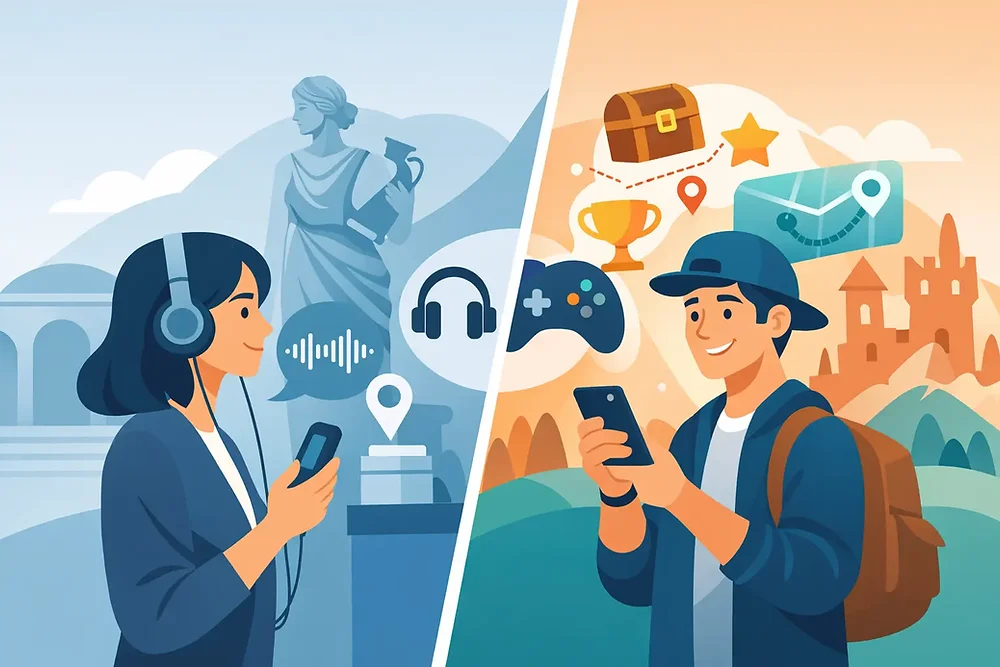
A visitor reaches a historic square, looks at a statue, and pulls out their phone. One experience starts talking. The other asks them to spot a symbol, follow a clue, and collect a virtual item hidden in the streetscape. That is the real difference in audio guides vs gamified tours: one delivers information, while the other gives people a reason to move, notice, and participate.
For travelers, the choice shapes how a city feels. For tour creators, destination teams, and cultural organizations, it shapes engagement, reviews, repeat use, and revenue. Neither format is automatically better. The strongest option depends on the place, the story, and the behavior you want to inspire.
Audio Guides vs Gamified Tours: The Core Difference
An audio guide is built around listening. It usually follows a route or collection of points of interest, delivering narration when a traveler arrives at a landmark. The best versions use strong local voices, atmospheric sound, useful context, and clear directions. They are familiar, easy to understand, and often ideal for visitors who want expert interpretation without joining a fixed group.
A gamified tour is built around action. It can use GPS triggers, missions, puzzles, timed challenges, collectible items, choices, rankings, or story chapters to turn the city into the interface. Instead of simply hearing that a building once housed a secret society, participants might decode a clue from its facade or find the next location through a historical riddle.
That shift may sound small. It is not. Listening is passive by default, even when the narration is excellent. Gameplay asks for attention. It creates micro-decisions, small wins, and forward momentum. The traveler is not only consuming a story. They are helping reveal it.
When Audio Guides Still Shine
Audio guides remain a smart format for many travel experiences. They are especially effective when the subject needs careful explanation: an art collection, a battlefield, a complicated archaeological site, or a neighborhood where the details matter more than the route.
They also work well for travelers who prefer a calm, self-paced visit. Someone on a solo museum day may want to linger over a painting, replay a segment, and avoid the pressure of a challenge. Accessibility matters here too. A clear audio-first experience can be more comfortable for users who do not want to constantly look at their screen or interact with game mechanics.
For creators, audio can be the faster product to produce. A compelling script, quality recording, location mapping, and a mobile delivery system can create a valuable digital tour without designing game logic. If the core asset is a remarkable narrator, a local expert, or a powerful oral history, audio should not be treated as outdated. It should be treated as a format with a specific job.
The limitation is that audio alone competes with a traveler’s surroundings, messages, photos, and endless mobile distractions. If the route lacks a strong sense of progress, some users will listen to a few stops and drift away.
Why Gamified Tours Create Stronger Recall
People remember what they do. A clue found in a narrow alley or a challenge completed beside a city gate becomes part of the memory of the trip. That is the commercial and creative power of gamification in tourism.
A well-designed game layer makes visitors look closer. It can lead them beyond the obvious landmark, encourage them to compare details, and reward curiosity at exactly the moment it appears. These mechanics are not decoration. They guide attention.
Gamified tours are particularly strong for friend groups, couples, families with older children, team events, and travelers who have already seen the headline attractions. They provide a shared mission, which changes the social energy of a walk. Instead of asking, “Where should we go next?” participants have a reason to keep moving together.
They can also make local storytelling feel more immediate. A mystery route can introduce a city’s forgotten characters. A treasure hunt can connect independent shops, public art, and overlooked streets. A cultural institution can use challenges to transform historical facts into discoveries rather than lectures.
The best experiences do not force a game onto every location. They connect each mission to the meaning of the place. A random QR code, generic trivia question, or leaderboard with no narrative purpose will feel like marketing noise. The goal is not to turn every city into an arcade. It is to give exploration a pulse.
The engagement advantage
Games create a clear progression loop: find something, solve something, earn something, and see what comes next. That loop helps self-guided travelers stay engaged through a longer route. It also gives creators useful opportunities to structure a story in chapters rather than as a sequence of disconnected stops.
For a destination brand, that progression can encourage movement into areas visitors might otherwise skip. A route can start near a famous attraction and lead toward a creative district, waterfront, market, or heritage site. The visitor gets a better experience, while local businesses and lesser-known neighborhoods gain more visibility.
The Trade-Offs Creators Need to Plan For
Gamified tours require more design discipline than audio tours. A great challenge must be easy to understand, safe to complete in public space, relevant to the narrative, and realistic for visitors with different mobility levels, languages, and devices. Location accuracy matters. So do instructions, pacing, and backup paths when a site is closed or crowded.
There is also a risk of overbuilding. Too many mechanics can bury the story. If every stop demands a puzzle, users may feel tested rather than invited. Strong tour design mixes modes: a quick visual observation at one stop, a short piece of audio at another, a choice that changes the route, then a moment to simply take in the view.
Audio guides have their own trade-offs. They may be simpler to produce, but quality is visible through the listener’s ears. Flat scripts, poor sound, and generic facts can make a city feel interchangeable. An audio guide must earn attention through voice, insight, and pacing.
For both formats, the route itself is the product. No amount of technology can rescue a weak story or a walk that ignores heat, hills, opening hours, safety, restrooms, and realistic travel time.
Choosing the Right Format for Your Audience
Start with the intended moment, not the technology. Is the experience meant to help a first-time visitor understand a major cultural site? Audio may be the right foundation. Is it designed to turn an ordinary afternoon into a shareable adventure? A game-based route is likely the stronger choice.
Think about group behavior as well. Solo travelers often appreciate flexible narration and a personal pace. Couples and friend groups frequently respond to collaborative missions. Corporate groups and event attendees may value competition, team scoring, and a clear finish point. A school group may need simple tasks, educator controls, and content tied to learning goals.
Budget and maintenance should shape the decision too. A basic audio experience can be launched quickly, but it still needs updates as streets, venues, and visitor needs change. Gamified tours can command higher perceived value when they deliver a distinctive adventure, yet they require testing in the real world and occasional refreshes to keep missions accurate.
The most effective answer is often a hybrid. Use audio where a voice adds texture, emotion, or expert perspective. Add missions where interaction helps visitors understand the environment. Let the traveler hear the legend, then ask them to find the evidence.
A Better Product for Modern City Exploration
Mobile-first travelers do not need another screen demanding their attention. They need a reason to look up. That is why location-aware gameplay has become such a powerful layer for urban exploration. It uses the phone to pull people deeper into the physical world, not away from it.
Platforms such as Leplace make this model practical for creators who want to package local knowledge as an interactive self-guided experience. A guide, tourism office, museum partner, or event organizer can build story-led routes that combine places, challenges, and digital rewards without treating every visitor like they belong on a traditional group tour.
The opportunity is bigger than replacing a brochure. A memorable tour can extend dwell time, introduce new parts of a city, create an activity people want to share, and give local stories a format that feels made for the way people travel now.
Build for the moment when a traveler pauses at a corner and wonders what happens next. If your experience has a compelling answer, the city becomes more than a backdrop. It becomes the game board, the stage, and the story they will still be talking about after the trip.
Enjoyed this post?
Comments
Be the first to comment.