
Aug 7, 20268 min read
Mobile Tour Platform for Museums That Moves
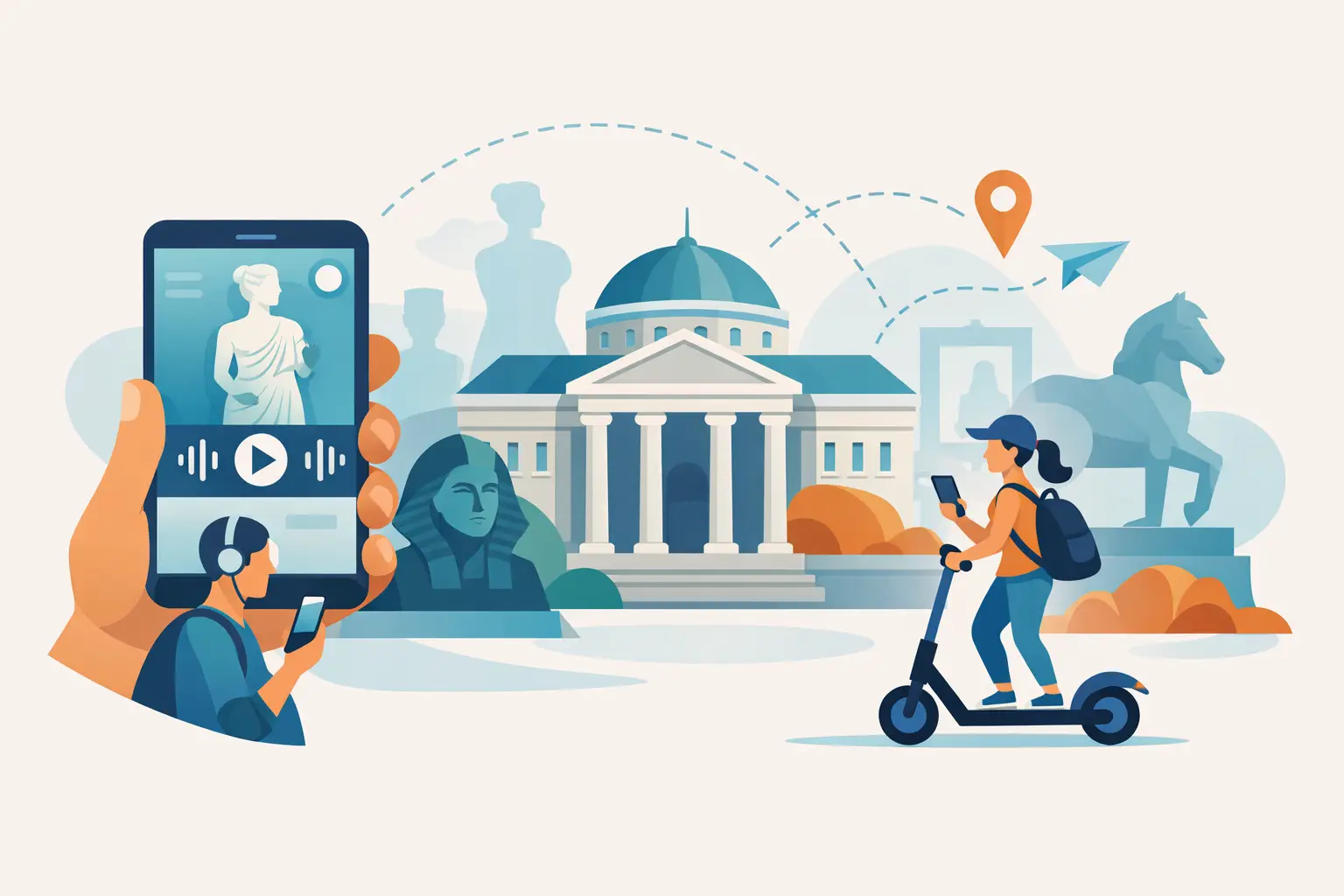
A museum visitor pauses in front of a painting, checks a label, takes a photo, and moves on. A mobile tour platform for museums can change that moment. Instead of asking visitors to consume information, it can invite them to solve a clue, follow a character’s route through the galleries, collect digital objects, or choose the next story they want to uncover.
That shift matters because audiences already carry the most personal screen in their pocket. The question is not whether museums should use mobile. It is whether the experience gives people a reason to look up, move with purpose, and remember what they found.
Why museums need more than a digital audio guide
Traditional audio guides still have a place. They work well for visitors who want expert interpretation, accessibility support, or a focused route through a major exhibition. But a long sequence of numbered tracks can feel passive, especially for younger visitors, families, repeat guests, and travelers who expect to explore on their own terms.
A strong mobile experience does not simply transfer wall text to a phone. It uses the phone to create participation. GPS can guide visitors between sites in a museum district. Location triggers can reveal a story when someone reaches a specific gallery. Challenges can turn observation into action. A visitor might be asked to spot a hidden symbol, compare two objects from different eras, or make a choice that changes the route ahead.
The result is not a smaller museum on a screen. It is a more active visit in the real world.
For museums, this also creates a practical opportunity. A digital experience can extend beyond opening hours, support temporary exhibitions without printing new materials, and provide an alternative path for visitors who do not want to join a scheduled group tour. It can help a collection feel alive without asking staff to repeat the same talk all day.
What a mobile tour platform for museums should actually do
Not every mobile product is built for cultural storytelling. A museum needs more than a map, a list of stops, and a generic audio player. The right platform should give curators, educators, and visitor-experience teams room to shape an experience with a clear beginning, momentum, and payoff.
Turn collections into missions
The best museum tours begin with a premise, not a menu of artifacts. A natural history museum could frame a route as an expedition to restore a lost ecosystem. A local history museum could ask visitors to investigate how one neighborhood changed over a century. An art museum could build a color-based challenge that sends guests looking for visual connections across rooms.
Missions give visitors a reason to keep moving. They also make interpretation easier to retain because facts arrive inside a story. Rather than reading that an object was used in a particular ritual, a visitor might collect clues that reveal why the ritual mattered to the people who practiced it.
This approach should not trivialize serious subjects. Museums working with conflict, colonial histories, trauma, or sacred materials need thoughtful framing and clear curatorial control. Gameplay is useful when it encourages closer attention, not when it turns difficult history into a scorecard.
Make self-guided feel intentional
Self-guided should never mean unstructured. Visitors need to know where to start, what they are trying to discover, and how long a route is likely to take. A good mobile tour offers direction without making everyone follow the same rigid path.
That can mean presenting a 30-minute highlights route for travelers, a deeper 75-minute experience for culture-focused guests, and a family mission with simpler prompts and frequent rewards. It can also mean allowing a visitor to skip a crowded gallery and continue without breaking the story.
Flexibility is one of the biggest advantages of mobile. Still, too many choices can create friction. Keep the first action obvious. Let the experience reveal complexity as visitors progress.
Build for the spaces between exhibits
Museum storytelling does not begin and end at the display case. Entry halls, courtyards, museum shops, public art, and nearby historic streets can all become part of the journey. This is especially valuable for institutions with multiple buildings, open-air collections, heritage sites, or city-center locations.
A platform that supports location-based experiences can connect indoor and outdoor discovery in one flow. A visitor might begin with an outdoor architectural challenge, enter the museum to investigate the people behind the building, and finish with a prompt that points them toward a nearby landmark. The museum becomes a launchpad for the wider story of place.
Design for attention, not screen time
The goal is not to keep visitors staring at a phone. The goal is to use short digital prompts to send their attention back to the object, room, or street in front of them.
That requires disciplined content design. Audio clips should earn their length. Questions should be answerable by looking closely, not by guessing. Visual overlays should add context that cannot be achieved with a label alone. If an AR-style feature is included, it should reveal a vanished building, reconstruct an object, or create a useful comparison. A floating logo over a sculpture is not an experience.
Short interactions usually work best: a 20-second story, a visual clue, a quick choice, then a reason to look around. Longer content can be available for visitors who want it, but it should not slow down everyone else.
Accessibility has to be part of this design from the first draft. Offer captions and transcripts for audio, readable type, high-contrast options, clear language, and alternatives to tasks that depend on color, sound, stairs, or precise movement. A mobile experience can widen access, but only if it is designed for different bodies, needs, and ways of learning.
Start with one route that can prove the idea
Museums do not need to digitize every gallery at once. In fact, launching with a focused pilot is often the smarter move. Choose a collection, exhibition, or neighborhood story that already has a strong narrative and a clear audience need.
A temporary exhibition is a good candidate because it creates urgency and gives the team a defined test period. A permanent collection can also work if it has a challenge visitors often face, such as low engagement in a particular wing or difficulty connecting objects across time periods.
Before building, decide what success looks like. Is the goal to increase dwell time? Create a better family experience? Encourage visitors to explore beyond the headline objects? Generate revenue through a premium route? Support a tourism partner with a museum-and-city trail? Different goals call for different mechanics.
Then test the route in the actual space. Watch where people hesitate. Check whether GPS behaves reliably outdoors and whether indoor instructions are clear without it. Notice where lighting, noise, crowds, or weak Wi-Fi change the experience. The most polished content can still fail if a visitor cannot tell which doorway to use.
A creator-focused platform such as Leplace can give cultural teams a faster way to publish story-driven routes without building a custom app from scratch. The advantage is speed and flexibility. The trade-off is that a museum should still invest time in its own narrative, visual identity, and testing. Technology provides the stage. The institution still has to create the reason to explore.
Give every interaction a job
When planning a tour, every stop should do at least one of three things: orient the visitor, deepen understanding, or create momentum. If it does none of these, it may be content for a web page rather than a mobile route.
A welcome stop orients. It explains the mission and sets expectations. An object-based prompt deepens understanding by asking visitors to notice a material, gesture, detail, or contradiction. A challenge creates momentum by giving them a destination or a small win that carries them forward.
Rewards do not need to be flashy. A completed chapter, a newly revealed historical image, a digital collection item, or an ending that reframes the first object can be enough. The strongest payoff is often emotional: visitors leave feeling that they found something for themselves rather than being told what to see.
Measure behavior, then improve the story
A mobile tour gives museums a clearer picture of how people move through an experience. Completion rates can show whether a route is too long. Drop-off points can reveal confusing instructions or a weak section of the story. Popular stops may indicate where visitors want more interpretation.
Treat the data as a conversation, not a verdict. If visitors skip a stop, the issue might be weak content. It might also be a crowded room, poor signage, a broken trigger, or a route that asks people to backtrack. Pair usage data with staff observations and visitor feedback before changing the experience.
There is also a privacy responsibility. Be transparent about what is collected, gather only what is useful, and make the experience valuable even for guests who choose not to share more than necessary. Trust is part of the visitor experience.
Make the museum a place to play, notice, and return
The most exciting museum mobile experiences do not compete with the collection. They make the collection harder to ignore. They turn a hallway into a trail, a label into a clue, and a familiar object into the start of a new question.
Start with one story worth following. Give visitors a mission that rewards curiosity. Then let the real gallery, artifact, and city do what no screen can do: make discovery feel physical, personal, and worth coming back for.
Enjoyed this post?
Comments
Be the first to comment.