
Aug 17, 20267 min read
Tour Builder vs Custom App: Which Fits Your City?
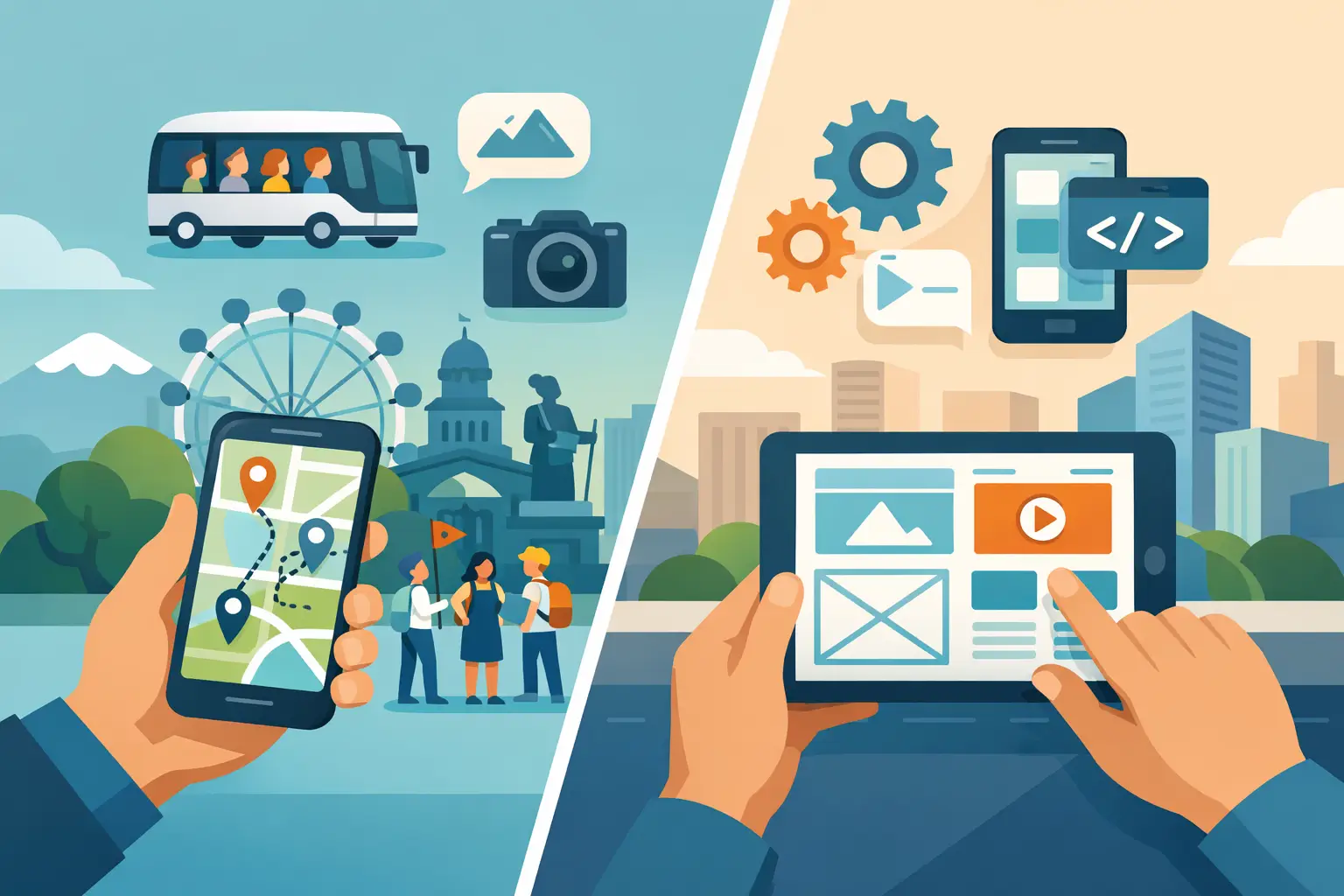
A visitor is standing in front of a mural, phone in hand, ready for the next clue. Your city experience has one chance to keep that momentum moving. The tour builder vs custom app decision is not really about choosing software. It is about deciding how quickly you can turn local stories into an interactive experience people will actually finish, share, and recommend.
For tourism teams, guides, museums, and event organizers, the best answer depends on the experience you are building, the resources behind it, and how much technology you truly need to own. A custom app can be powerful. A tour builder can get your experience into the real world while the moment is still relevant.
Tour Builder vs Custom App: The Core Difference
A tour builder is a ready-to-use platform for creating mobile, location-based experiences. You bring the route, stories, media, challenges, and local knowledge. The platform supplies the mobile framework: maps, GPS triggers, content delivery, user flows, publishing tools, and often payment or access controls.
A custom app is built specifically for your organization. You define every feature, interface, integration, and branded interaction, then pay a development team to design, build, test, launch, and maintain it.
The distinction matters because a digital tour is rarely just a set of pins on a map. Great self-guided experiences need clear navigation, engaging prompts, reliable location behavior, good mobile performance, and a reason for participants to keep walking. If you want scavenger hunt mechanics, virtual collectibles, photo missions, timed challenges, or branching stories, those systems must work in the field, not just look impressive in a presentation.
A tour builder starts with the infrastructure already in place. A custom app starts with a blank canvas and a longer runway.
Choose a Tour Builder When Speed Creates Value
Cities change quickly. A festival launches, an exhibition opens, a tourism campaign gets funded, or a new district needs attention before the next travel season. In these cases, speed is not a convenience. It is part of the business model.
A tour builder is usually the stronger choice when your team wants to publish and iterate without waiting through a full software cycle. A local guide can turn a neighborhood walk into a GPS-enabled exploration game. A destination marketing organization can test several themed routes. An event producer can create a temporary challenge trail that disappears when the event ends.
This is also where creator control becomes practical. Instead of sending every content change to a developer, the people closest to the story can update clues, replace images, revise stop descriptions, adjust routes, and experiment with new missions. That creates a living product rather than a digital brochure that becomes outdated after launch.
Platforms such as Leplace are designed for this model: creators can package local knowledge into interactive self-guided tours built around real movement, gameplay, and discovery. The technology supports the experience, while the creator remains focused on what visitors remember - the hidden courtyard, the surprising fact, the challenge that turns strangers into a team.
A tour builder is especially compelling if you need to validate demand. Before investing heavily, publish one route, invite real users, and watch what happens. Do participants reach the final stop? Which challenge gets shared? Where do they pause or drop off? Those answers are more valuable than internal assumptions.
Choose a Custom App When the Product Is the Platform
A custom app makes sense when your mobile product has requirements that extend far beyond a tour experience. Perhaps you need deep connections to a ticketing system, loyalty program, customer database, hardware installation, proprietary content engine, or enterprise security environment. Maybe the app is central to a large attraction, a multi-year destination ecosystem, or a membership product with a large active audience.
Custom development also gives you greater control over visual design, data architecture, feature priorities, and brand presentation. If your organization has a distinct digital ecosystem and the budget to support it over time, that control can be valuable.
But control is not the same as freedom from constraints. A custom app means owning the decisions that come after launch: operating system updates, bug fixes, accessibility improvements, privacy requirements, app-store reviews, device testing, analytics maintenance, and new feature requests. The first version is only the beginning.
The question is not, “Could we build our own app?” Almost any organization can. The better question is, “Do we need to operate a software product for years to deliver this experience?” If the answer is no, building from scratch can drain budget and attention from storytelling, marketing, partnerships, and visitor acquisition.
Compare the Real Costs, Not Just the Launch Price
The initial quote is often where the comparison goes wrong. A custom app may appear to offer everything in one package, but its true cost includes discovery, UX design, engineering, quality assurance, project management, launch support, and ongoing maintenance. Changes that take minutes in a creator platform can become scoped development work.
A tour builder typically shifts that equation. You pay for access to existing technology rather than funding its creation. That lowers the barrier for small operators and makes experimentation more realistic for larger teams. It can also reduce risk when a campaign has a limited duration or uncertain audience size.
Still, a tour builder is not automatically the low-cost answer in every situation. If you have a highly specialized workflow that a platform cannot support, forcing your project into a prebuilt structure can create operational friction. And if you are operating at a scale where platform fees grow significantly over time, a custom product may deserve a closer financial model.
Calculate beyond development. Include the value of launching earlier, the cost of delayed revenue, the staff time required to manage content, and the investment needed to keep an app relevant after year one.
The Guest Experience Should Lead the Decision
Travelers do not care whether your experience was built with custom code or a tour builder. They care whether it is easy to start, exciting to follow, and worth talking about after the trip.
For many audiences, downloading a single-purpose app can be a hurdle. A visitor may be willing to scan a code and begin a self-guided route, but less willing to create an account and install another app for a 90-minute activity. That behavior matters for city tours, pop-up activations, conference programs, and one-time cultural events.
What keeps people engaged is active participation. A strong route asks them to look up, look closer, solve something, choose a direction, collect a digital reward, or uncover a story that would otherwise remain invisible. This is why the format matters more than the technology label. A beautifully branded custom app with passive content may feel less memorable than a platform-built experience that turns a city block into a real-life exploration game.
At the same time, some experiences demand the deeper continuity of a custom product. If guests return weekly, track long-term progress, interact with a large member community, or use features beyond tourism, a dedicated app may better serve the relationship.
A Practical Decision Test for Experience Teams
Start with your audience and your launch goal. If you need to activate a place quickly, test a concept, equip multiple creators, or produce several routes across locations, a tour builder is likely the more strategic starting point. It helps you go from story to street without turning your organization into a software company.
If your experience relies on proprietary systems, advanced integrations, or a long-term digital product strategy, a custom app may be justified. Just budget for the full lifecycle, not the launch announcement.
There is also a smart middle path. Launch with a tour builder, prove the audience and refine the format, then consider custom development only when real usage shows that the platform limits growth. This approach replaces expensive guesswork with field-tested evidence.
The city is already your interface: its streets, storefronts, parks, architecture, and overlooked stories. Choose the technology that lets people step into that world sooner, then give them a reason to keep exploring.
Enjoyed this post?
Comments
Be the first to comment.